Essay: Writing trauma

‘First person narrators can’t die so as long as we keep telling the story of our own lives we’re safe. Ha bloody fucking Ha.’ [1]

Experience is not neat, well organised. Life is full of knots, but there is a line through.

War is a terrible experience, so why is so much written about it? Diaries, news reports, fiction: we write war, read it, it fills the shelves in newsagents, libraries and bookshops.

Survivors of war emerge changed. Life is shifted by war: previous experience looks different through the lens of survival, a lens sharpened by the deaths of others. This drives the need to tell the new story, and through that find the re-formed self. Those who have been through life changing experiences are often compelled to tell, talk, blog, write, to reclaim their story. Those whose lives are swept away by trauma, write in order to take control … only I can write my story.

Writing in the midst of trauma may not reach the whole experience. Paul Fussell quotes Robert Kee, a RAF flyer in the second world war, writing about his diary: ‘From all the quite detailed evidence of these diary entries I cannot add up a very coherent picture of how it really was to be on a bomber squadron in those days … No wonder it is those artists who re-create life rather than try to recapture it who, in one way, prove the good historians in the end.’ [2] Writing after trauma takes time. Walter Benjamin notes in The Storyteller, ‘ten years later … poured out in the flood of war books’[3] and this is reflected by Siegfried Sassoon who wrote his memoir around ten years after the war.[4] Time shifts experience into something else.

In writing trauma there are a number of participants: the person who has had the traumatic experience, and the author. Sometimes they are the same person. Every author requires a reader to function as witness. This paper is grounded in triangles where borders between experience and fiction shift. This is exemplified in Siegfried Sassoon’s experience in WW1, his poetry and memoirs, and Pat Barker’s fictionalised version of his experience. It also rests on my creative writing, my writing about other people’s experiences, and my critical and autoethnographic analysis. Overarching both these set-ups is the two-fold question: why write trauma, why write trauma that belongs to someone else? In this section of the paper I examine trauma and the need to write, of those who have experienced it, those who write it, and those who witness it on their behalf.

In Regeneration, in the conversation from which this dissertation takes its title, Wilfred Owen and Siegfried Sassoon discuss pig keeping, poetry and ergotherapy, the theory on which Dr Brock is basing his treatment of Owen. Owen says, ‘He thinks we – the patients – are like Anteaus in the sense that we’ve been ungrounded by the war. And the way back to health is to re-establish the link between oneself and the earth, but understanding ‘earth’ to mean society as well as nature.’[5] The whole conversation is grounded in earth: the men joke about keeping pigs after the War (and insist that pigs are clean animals – not dirt, not death). They discuss how Hercules lifted Antaeus off the ground and talk about Owen’s poem, The Inspection:

Some days ‘confined to camp’ he got,

For being ‘dirty on parade’.

He told me, afterwards, the damnèd spot

Was blood, his own.

‘Well, blood is dirt,’ I said.

‘Blood’s dirt,’ he laughed, looking away,

Far off to where his wound had bled

And almost merged for ever into clay. [6]

In giving Owen departing instructions to work on his poetry, Sassoon says, ‘You’ve got to sweat your guts out’,[7] an earthy description of writing, made all the stronger as both men have seen men’s guts exposed. In a world of strangeness and uncertainty, where life teeters on an edge and the abyss of death is visible, writing can be grounding. In a world where, ‘Men who broke down, or cried, or admitted to feeling fear, were sissies, weaklings, failures,’[8] writing was a legitimate outlet. At a time when talking about feelings was riven with conflict for men, writing provided a foundation, a place to process life changing trauma.

Trauma is hard to face but it cannot be ignored. Adorno raised questions about the possibility of writing poetry after Auschwitz. He then wrote, eleven years later, time shifting his perspective, ‘The abundance of real suffering tolerates no forgetting; Pascal’s theological saying, On ne doit plus dormir, must be secularized. Yet this suffering, what Hegel called consciousness of adversity, also demands the continued existence of art while it prohibits it.’[9] Humans are compelled to write trauma, read it, view it again. Trauma prohibits art, but demands it, and Walter Davis suggests in his paper, Death’s Dream Kingdom: The American Psyche After 9-11 , we may be compelled to live it again.[10] One must sleep no more, no longer. A decade passes, it is time to wake up from the repeating dream, and seize it, take control, create art and poetry, create a new self. Adorno continues: ‘it is now virtually in art alone that suffering can still find its own voice, consolation, without immediately being betrayed by it.’ Art and writing are different from factual portrayals of traumatic experiences. Images of war burn in the mind, remain as scar tissue. Owen’s poetry does more than any list of facts to convey what happened. Writing, poetry, photography reach across time and space and allow us to create memorials to the past, new stories for the future. Those who have experienced trauma can feel that they have created something that stands apart from them, that can be exhibited, and as a result there are witnesses to their pain.

Artistic recreation and repetition of trauma, of tragedy, has occurred over thousands of years. War writing is not always but often tragic. AD Nuttall suggests in his book Why Does Tragedy Give Pleasure? that there have been different answers to his titular question at different times.[11] In ancient Greek theatre, audiences enjoyed catharsis, ‘The purification of the emotions by vicarious experience’.[12] No one really dies: horrible events are controlled and resolved. Even a death in a tragedy comes with a sense that it is the correct resolution. But it is more complex than simply rejoicing in death under control. There is a battle between our innate aggression – one primitive instinct – and our need for civilisation, for Eros – love. Reading, writing tragedy, where the end is a death of some sort that is simultaneously wrong and right, allows us to feel this conflict. Tragedies are consoling because they are in the past, complete – but unsettling because they resonate with now. They must have a message that transcends time. The strongest message to be written is death, we cannot escape it however fast we write, read, run. Tragedy is Walter Benjamin’s death in the misapprehension that he would be deported back to France from Spain as he tried to escape the Nazis. Tragedy is rooted in reality, in one death, the death of millions in war, in works like Wilfrid Owen’s Futility which highlights the pointlessness of life:

‘O what made fatuous sunbeams toil

To break earth’s sleep at all?’[13]

The dreams of shell-shock victims forced Freud to reframe his concept of dreams as wish-fulfilment: a compulsive repeating return to traumatic experiences did not match up with his pleasure principle. Ellmann writes that in comparing the compulsion to repeat to his grandson’s game of ‘Fort – Da’, Freud found that it ‘resembles tragic drama, which inflicts upon the audience the painful experience of loss, while wresting pleasure out of the aesthetic mastery of that experience.’ Freud concluded that, ‘The compulsion to repeat overrides the pleasure principle’.[14] This compulsion to repeat links to writing trauma and the death drive. Freud himself writes, ‘the goal of all life is death’.[15] I feel this in my writing, can see it in the writing of others: there is a desire for the outcome of publication, the need for an end, for death. This paper repeats a theme that drives through my writing, compels me to write trauma. Freud wrote, ‘the aim of the second [drive] is, by contrast, to dissolve connections, and thus to destroy things … we also call it the death-drive’.[16] Here is a conflict: writing creates rather than destroys, the desire to destroy connections seems in direct opposition to the desire to create. However, in writing, creating one thing destroys something else. Writing a fictionalised memoir of a traumatic experience destroys feelings of lack of control. Perhaps for the author who has not experienced the trauma but is writing someone else’s trauma, as Barker is, writing trauma is still about making sense, about taking control. There is still compulsion to repeat. An event like WW1 compels people to make sense of it over and over again. Considering the death drive further, Bennett and Royle explain: ‘everyone at some level (consciously or unconsciously) is driven by desire to die, to self-destruct, to return to a state of inanimacy. By a sort of uncanny reversal or displacement of perspective, then, life would not be about living, progressing and developing, about pleasure, vitality and staying healthy.’[17] This contributes to the need to write trauma: life is about the desire to die, to find an end, to read, to write an end. Nuttall suggests that Freud’s death drive is: ‘Contrary to popular belief… not primarily a wish for one’s own death but a desire to inflict death on others.’[18] This makes sense in the context of writing and reading fiction about traumatic experiences where one safely inflicts death on others. Nuttall expands on catharsis, and develops it into the idea of exercising emotion – different from passive purging – imagining, watching, dreaming, writing tragedy is in fact preparing ourselves for possible futures. He writes, ‘For the process to work, two things need to be the case: first, the situation must be hypothetical rather than categorical (as football is hypothetical warfare, not actual) and, second, that it should nevertheless involve a probable relation to real danger.’[19] The better the writer, the more real literary danger feels. This is about seizing the death instinct and the human fear of death, embracing the conflict on a safer page or stage, and preparing ourselves for what must come.

Returning to Ellmann’s concept that we write to gain pleasure from aesthetic mastery, what does that mean now? Writing gives us a controlled, albeit temporary, solution to pain, to death, to the desire for death and the need to control it, practice it. Given the popularity of crime stories, war stories, detective stories where the end is neat and the pain we experience imaginary, I suggest that, in line with Freud’s death drive, some part of us is addicted to pain, to death, but beyond that, addicted to the idea that we can control it, that there is a neat resolution where death feels right. It is present in humour when someone else’s pain is entertaining, neutered as the clown stands up and grins after a fall. We rate a good book as one that seduces us to think it is real, we relish life experiences in safety: a commuter reads a thriller on the train, transported to a world rife with adrenaline charges, yet arrives home safely. The book-buyer’s life is safe: books supply something that we crave. Readers and writers are as much experience junkies as those who climb, abseil, skydive. Addiction, repetition: we seek that thrill again and again.

Peter Brooks expands on the idea of story and repetition in Freud’s Masterplot:

‘Narrative always makes the implicit claim to be in a state of repetition, as a going over again of a ground already covered: a sjuzet repeating the fabula, as the detective retraces the tracks of the criminal. This claim to an act of repetition – ‘I sing of’, ‘I tell of’ – appears to be initiatory of narrative. It is equally initiatory of Beyond the Pleasure Principle: it is the first problem and clue that Freud confronts. Evidence of a ‘beyond’ that does not fit neatly into the functioning of the pleasure principle comes first in the dreams of patients suffering from war neuroses … : dreams that return to the moment of trauma, to relive its pain in apparent contradiction of the wish fulfilment theory of dreams.[20]

That returns us to trauma. In writing trauma we seize control of the dreams that will not go away, we become our own heroes, we create our own plot, meaning and end. There is pleasure in rereading a book, trusting the author for resolution. Even if the end is death we feel a sense of rightness in that end. Echoing Nuttall’s concept of the shift from passive catharsis to active exercise of emotions, Brooks writes, ‘the essential experience involved is the movement from a passive to an active role … claiming mastery in a situation to which he has been compelled to submit’ … ‘by this choice he asserts an active mastery of what he must in fact endure’.[21] In Barker’s book, Owen starts a sentence and Sassoon finishes it: ‘”It’s mad not to write about the war when it’s-” “Such an ‘experience’”.[22] They laugh, expressing the insanity, conflict and compulsion in writing about trauma. They write, must write, must take control of the dire situation that they find themselves in at the front, they continue to write until Owen at least is stopped by death. Brooks continues his explanation, ‘We have moved from a postulate of repetition as the assertion of mastery … to a conception whereby repetition works as a process of binding toward the creation of an energetic constant state situation which will permit the emergence of mastery and the possibility of postponement.’[23] Mastery repeats, across Ellmann and Brooks’s writing and within Brooks’ piece. Mastery is about authority, power, dominion, skill. Authorship is rooted in authority, takes skill, gives power and dominion over one’s characters. A number of papers link shell-shock, and indeed Regeneration to the issue of gender.[24] In brief and inadequate summary, shell-shock is allied to female hysteria, forced on men by the relative immobility of trench warfare. Mastery is linked to manhood: ‘The term master was originally applied almost exclusively to men …, is still normally used of a masculine referent’.[25] The battle to overcome a ‘female malady’ is won with mastery of a situation by writing. Mastery seems inextricably linked to that which is taken away by disempowerment, the futility Owen feels in his poem of that name, the irony that Owen and Sassoon use when discussing why one should write about the war. In both the Sherston and the Regeneration trilogies, being a soldier involves following orders without asking for a rationale, taking orders that seem nonsensical, and waiting without any knowledge of exactly what for. Following, taking orders, waiting: all passive actions. Writing is in this situation a way to exercise the emotions, as per Nuttall, to develop mastery, as per Brooks.

For the writer of today, for myself, perhaps for Barker, writing gives mastery over the unfathomable. We seek to deal with the fear of death, to anticipate disaster, to practice it, to fend it off by gripping it tight. We write trauma, because events like WW1 do not go away. It is not the achievement of mastery that is the goal, but to travel through life with hope of mastery. Death is less terrifying if one feels that one can come closer to it, examine it and walk away alive.

Returning to the question of the person who tells, who writes, their own trauma, Adorno writes,

‘Perennial suffering has as much right to expression as a tortured man has to scream; hence it may have been wrong to say that after Auschwitz you could no longer write poems. But it is not wrong to raise the less cultural question whether after Auschwitz you can go on living–especially whether one who escaped by accident, one who by rights should have been killed, may go on living.’[26]

Adorno reconsiders his statement that has echoed throughout writing since he made it. He addresses the question of how you can live after Auschwitz, how you can live when you could have died, should have died. For me, living and writing go hand in hand. He focusses in, further examining those who have escaped by accident and that links to the work I have done with Joe, to the writing of other trauma survivors. Whatever the event, whether individual or with global impact, survivors have to address the question, ‘Why am I still alive?’. This returns us to the function of writing a story: to create meaning and resolution. When death touches you, it changes you, and this needs to be documented: where was I, where am I now? Life’s value shifts: trauma can raise the value of life, but at other times can make it feel pointless. Men returning home after war lose the ability to live without adrenaline rushes.[27] When you have come through trauma there is guilt: why them, not me? Writing assuages this with the ‘duty to tell’ – something that rings through Siegfried Sassoon’s statement.[28] Writing is grounding, as Sassoon and Owen discuss in Barker’s Regeneration: it creates the certainty that the person plagued by dreams requires if he is to go on living. ‘Going on living’ is the opposite of death: it is hard and cannot be taken for granted post-trauma. Going on living when others have died brings with it not just guilt but the duty to bear witness. This is present throughout Don McCullin’s autobiographical narrative, Shaped by War as much as it is in Sassoon’s statement.[29] Ulrich Baer extends the duty of witness to those who see photographs of trauma. This is another motivation to write; to share the burden of being witness in the hope that if more people understand what has happened, is happening, it will not recur. Dori Laub extends this idea further as she explains how the process of narrating a traumatic event is part of the development of the trauma, where the ‘“knowing” of the event is given birth to’.[30] Narrating a life-changing event becomes a critical continuation and part of the event itself: the listener becomes a co-owner as he ‘comes to partially experience trauma in himself’. I write to process trauma, to share the burden.

Time brings events into focus again: with the 100th anniversary of WW1, a nation remembers, reads the war again. The attacks on September 11 2001 are the most recent ‘game changer’ in the way that WW1 was and continues to be. 9/11 compels us to revisit trauma as each anniversary drags us back. Corporate memorialising brings demands for stories: look in libraries, on TV schedules, on the internet: we are re-witnessing.

In a strange echo of the numbness and mutism that Prior experienced in Regeneration, one of Prior’s men, Hallet, is shot in the face with ‘a hole where his left cheek had been’.[31] He is returned to England but does not live long. In his dying hours, impaired by the damage to his face and jaw, he repeats the word shotvarfet, which Rivers eventually translates as ‘It’s not worth it’ The question of whether it is worth it, whether war justifies so much death and pain, is whole point of the Regeneration trilogy from Sassoon’s statement to the end where Prior and Owen go over the top. The question of whether it is worth it is that same question that we seek the answer to as we write trauma. As those who have experienced trauma seek to imbue it with meaning – I’m scarred, I’m new, I’m better – we seek the same message. We need to know that they neared death and passed it by. We hope to see that others have mastered death, and we might too.

At the end of the Regeneration trilogy, Billy Prior sees Wilfrid Owen die, ‘his body lifted off the ground by bullets, describing a slow arc in the air as it fell.’[32] Prior witnesses Owen’s death in his own last moments, traces of Anteaus. We read a story to the end, to the death. We continue to the last page to seek purpose, pause to take in the dying moments of the story, then seek a new book. The search for narrative meaning continues.

[1] Pat Barker, The Ghost Road (London: Penguin 1996) p118.

[2] Paul Fussell, The Great War and Modern Memory (Oxford University press 1975) p311.

[3] Benjamin, ‘The Storyteller’ p362.

[4] Sassoon, The Complete Works of George Sherston

[5] Barker, Regeneration, p123.

[6] Wilfred Owen, The Inspection http://www.wilfredowen.org.uk/poetry/inspection [Accessed July 2015]

[7] Barker, Regeneration p125.

[8] Barker, Regeneration p44.

[9] Theodor Adorno, ‘Commitment’, New Left Review I/87-88, (1974) http://newleftreview.org/I/87-88/theodor-adorno-commitment [Accessed July 2015]

[10] Walter A Davis, ‘Death’s Dream Kingdom: The American Psyche After 9-11’ Journal for the Psychoanalysis of Culture and Society, 8(1) (2003) p130

[11] A D Nuttall, Why Does Tragedy Give Pleasure? (Oxford: Clarendon Press, 1996)

[12] OED [Accessed online June 2015]

[13] Wilfred Owen, Futility, http://www.bbc.co.uk/poetryseason/poems/futility.shtml [Accessed July 2015]

[14] Maud Ellmann, Psychoanalytic Literary Criticism, (London: Routledge, 1994) p7.

[15] Sigmund Freud, Adam Philips, Ed. The Penguin Freud Reader, (London: Penguin, 2006) p166.

[16] Freud, p93.

[17] Bennett and Royle, p39.

[18] Nuttall, p74.

[19] Nuttall, p76.

[20] Peter Brooks ‘Freud’s Masterplot’ from Reading for the Plot: Design and Intention in Narrative (Cambridge, Mass.: Harvard University Press, 1984) p97.

[21] Brooks, p98.

[22] Barker, Regeneration p123-4.

[23] Brooks, p101.

[24] Elaine Showalter, The Female Malady (London: Virago Press 1987) p171. Lena Steveker, ‘Reading Trauma in Pat Barker’s Regeneration Trilogy’ in Susana Onega and Jean-Michel Ganteau, Eds, Ethics and Trauma in Contemporary British Fiction, (Amsterdam: Editions Rodopi 2011) pp21-36.

[25] OED [Accessed online July 2015]

[26] Theodor Adorno, Negative Dialectics, English translation by E. B. Ashton (London: Routledge 1990) p362-363.

[27] Paul Allen, The Warrior’s Code of Honour, http://www.militarycodeofhonor.com/WarriorsCodeofHonor/author/rattle956mrsbaker/ [Accessed June 2015]

[28] See Appendix 1

[29] see Appendix 2

[30] Dori Laub Testimony: Crises of Witnessing in Literature, Psychoanalysis and History (London: Routledge 1992) p57.

[31] Pat Barker, The Ghost Road (London: Penguin 1996) p196.

[32] Barker, The Ghost Road p273.
Prose poem: Mail up!

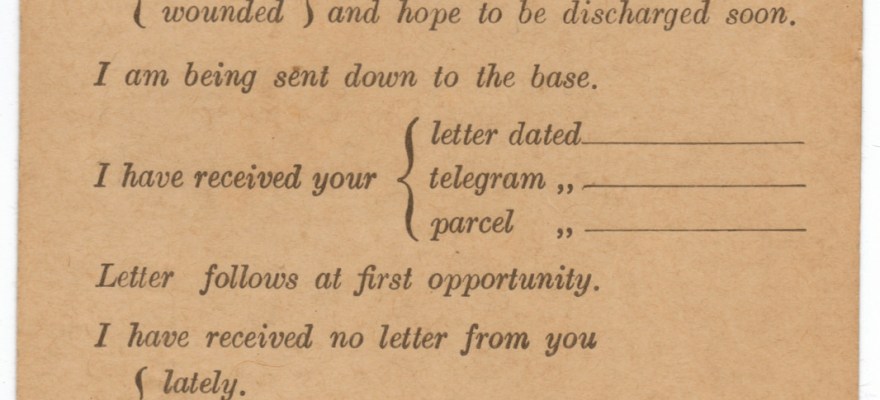
This is a prose poem from my dissertation based on the format of Field Service Postcard that soldiers were issued with during WW1.Field Service postcard.jpg


Mail Up!

NOTHING is to be written that tells the truth. Feelings not required will be erased. If I say what I mean the post card will be destroyed.

 I can’t tell you

 I am

quite

quite

quite        unable to tell you.

 I have been            shot at

bombarded

gassed

I am                         sickened

filthy

exhausted

I …

I have received your

hopes

wishes

dreams

 My body follows at first opportunity

 I have received no way out.

lately

at all.

 Signature

only                                       

Undated

[Postage must be prepaid on any letter or post card addressed to the sender of this card.] 

Review: Not Another Happy Ending


I have spent a lot of the last two years reading writing about writing, as I studied literary criticism. In Not Another Happy Ending I’ve been doing much the same but in a fun and light-hearted way for a change. David Solomons’ book, adapted from the screenplay for the film of the same name, takes all sorts of clichés about writing and shakes them up.

Have you ever written a dramatic domestic scene where the tension builds as the kettle rises to the boil? Read ‘Not Another Happy Ending’ and you’ll be taking the red pen to all mentions of kettles. What about stories of would-be novelists who get the deal of their dreams, and discover that the reality of being a successful author isn’t all they had hoped? Well, that’s the cliché that Solomon’s book explores. There’s a handsome French publisher, with a hapless assistant, who takes up Jane’s first novel, a ‘misery-lit’ thinly disguised story of her childhood. The book sales start slowly, but then take off. Jane wins an award, meets a Hollywood screenwriter who soon becomes her boyfriend, and reconciles with her father. For the first time in a long while, she’s happy. But … and there’s always a but … she has to write another book. Second novels are called ‘difficult’ for a reason, and Jane’s struggling with the weight of expectations, while her screenwriter boyfriend is happily working on the screenplay of her first book.

There are plenty of fun twists and turns in the tale – a pub quiz team, a character from Jane’s book who becomes real, a run down cottage in the wilds of Scotland, and a book launch on a double decker bus. In Not Another Happy Ending David Solomons has done a great job of delving into the preconceptions surrounding becoming a successful writer and shaking them up.

This is an easy read, and I’d recommend it for holiday reading for writers … and anyone else who wants a fun romance where the girl gets her guy, of course!

You can also watch the film on Netflix – the trailer is below.

ETA: Having now watched the film, it’s fine, it’s fun … but the book is better!


Not Another Happy Ending costs around £7.99 in paperback and £3.49 on Kindle at the time of writing

Sightlessness is another country (WIP) #whatimwriting

This is a difficult one to write, half resolved thoughts, a tiny idea that hasn’t been fully birthed.

I’ve been writing about sight loss. I take a privileged western man, and strip away his freedom, then to add to his nakedness, I take his sight.

I’ve been reading about post colonialism, because I know that I’m writing a western view on Africa. I need to take Adam from his home, from everything that keeps him safe, in order for him to change as a person. I’m taking him as far as I can out of his comfort zone, into new territory where he isn’t his own person, where he loses his identity, needs to find a new self.

I always consider what it means to write this as a woman, what it means to write about a man.

Somewhere in this I can see a thread linking sightlessness, sight loss, with landlessness, with colonisation, where the country you thought was yours is no longer yours, no longer home. Some place where unclear boundaries, wavering borders cause pain and trauma. Somewhere, land and gender, aid and disability, the relationship between doctor and patient all interlink. In this place, I challenge ‘I know what’s best for you’, in a place of self and other, of subject and object, of having and of loss. What I’m writing observes the shift between observer and observed, between seer and seen.

In the first version of Blindsided, the most experimental format, I wrote,

See. Seeing: we see without thinking, we ‘look, behold; observe, perceive, understand; experience, visit, inspect’. I see: I follow what you are saying. I see: I have (a) vision. Also, See, ‘throne of a bishop, archbishop, or pope’ from Latin sedem ‘seat, throne, abode, temple,’ related to sedere ‘to sit’. I do not see, I am unseated. “

Going back to the New Immortals, someone used the phrase, ‘The chaos of the indeterminate body’… ‘people don’t know how to die.’ Nothing prepares us for death, nothing prepares us to lose a sense, a limb, an ability. I couldn’t walk age thirty eight. That was a shock. And maybe that’s why everything I read is about death, why I see death in everything I read. This time, I want to be prepared. Or must we always be blindsided by what life throws at us? Are we inevitably unseated? Is the very unpredictability of life, of the human response what makes us want story? Are stories are a way that we can be prepared?

Returning to geography and disability, identity and power phrases that come up in my reading that resonate … unsettled states … nations without borders …missing borders … unclear borders. In writing about a rebel group in West Africa I need a clear strategy for what they are rebelling against. What is the identity that they are seeking to protect? What borders do not match with communities? What power do they lack? In writing about sight loss, I cast Adam into a space where he is seeking boundaries, where there is safety in limits and borders and danger in an unseen edge. He is dragged into a place where he can’t see the boundaries that used to be clear, and those borders he thought were stable, his identity as a man, a doctor, an employee, a volunteer, have all gone.  In the last part of the book Adam spends most of his time by the sea, a place where the border between land and water changes constantly. In this place of uncertainty, though, he finds something that he’d lost.

rassembler: to assemble, gather together
rassembler ses idées: to collect one’s thoughts
rassembler ses esprits: to gather one’s wits
rassembler son courage: to screw up one’s courage

Virginia Woolf writes, “As a woman I have no country. As a woman I want no country. As a woman, my country is the whole world.” (From Three Guineas, Woolf’s take on Patriarchy and Fascism) Looking up other people who have written about this quote, about the feminist politics of place, I stumbled across Adrienne Rich’s Notes Towards a Politics of Location. Rich expounds on the need to understand your ‘country’ … that she is, that I am writing as a middle class, privileged, white woman. She writes about ‘the body’, ‘my body’ and the difference between the two, the latter plunging her into ‘lived experience’. In writing a world where Adam is pulled from sighted to unsighted, from where he is privileged and in control to a situation where he has no power, where he loses a sense, I want him to be forced into a place of change, where he examines his privilege, that which he takes for granted.

The phrase ‘No Nation’ keeps recurring in my research – Robert J C Young uses it to paraphrase Woolf, and I’ve written about the film, Beasts of No Nation, based on the novel of the same name by Uzodinma Iweala. I’ve not yet found the source for Iweala’s title. In what I’m writing I’m aspiring to see what happens to a man when he loses his nation, his privilege, his seat, his sight. Rich writes, “We… often find it difficult to separate race from class from sex oppression because in our lives they are most often experienced simultaneously.” I guess I’m tying into knots the threads of white privilege and ability. I’m not sure about the final part of the book where Adam, sightless, returns to the home where he grew up. It is the easiest thing for him to do, in some ways the only choice he has as he struggles with his new self, but it is a choice of the privileged. He has a home to go to. And perhaps I need to change that, or maybe he needs to prove that he has changed against his former background. I don’t know.

There’s a lot of things I don’t know. Yet. This is a rough cascade of thoughts which I will return to.

To be continued …


What I’m reading, what I’m writing #whatimwriting #amwriting


I’ve been reading A House in the Sky: A Memoir of a Kidnapping That Changed Everything for more in depth research on being a hostage. In many ways this is one of the best books written (ghostwritten) that I’ve read on the subject so far, because Amanda Lindhout goes in more deeply to the felt experience of being kept prisoner. I don’t know if this difference is something to do with gender – the other books I’ve read so far are written by men, but I have more idea now about the parts that she found truly degrading: the dirt, the hunger, the chain pressing into her ankles, having to ask permission to go to the toilet, the lack of privacy. Her hostage experience starts off in a situation where she has a dialogue with her captors, where she still has some power, where there are boundaries, but by the end of her time in captivity it seems like she has become a thing to them, an object. I’ve written about this before in the context of doctors and patients: I think at some point during a doctors training they have to make the leap where they can regard the patient as ‘other’ in order to protect their own psyche. That’s where you end up with damaging beliefs for the health professional, like ‘doctors don’t get sick’. (And a better, more experienced doctor can cross the divide in both ways, empathising with the patient when needed, treating them as an object when slicing into them, perhaps.) And I can see how this objectification (?) can be necessary for a hostage taker in order to mete out the brutal treatment that Amanda Lindhout received. The challenge as a writer is in capturing the humanity and personhood of the person who is doing terrible things. The second draft of my book is going to have to go deeper, darker into Adam’s experience: at the same time I have to make his captors more human, more multifaceted.

Other things that came out of reading the House in the Sky were details of re-entry into normal life. Amanda’s teeth were damaged, she experienced stomach cramps when trying to eat after months with little food. She describes the feeling of the soft bed, her first night in a hotel after months on a mattress on the floor. And she touches on uncovering just what had been done to free her. I also looked at some videos from Nigel Brennan, her fellow captive, where he talks about what his family had to do to get him back. It is interesting that some parts of what was happening to them in captivity did get back to their families, small details that the families had no way of verifying at the time.

Reading other people’s written experiences is good, but I do wonder whether I should also be out interviewing people. I’d have no qualms doing this for non fiction, but I feel more hesitant about doing it for fiction and I’m not sure why. Part of it might be the long, indefinite process. I have no contract for this book, so no publication date, and I have no intention of being tied to any sort of deadline before I’m a lot further into the process! I also have qualms about seeking out people who have been through trauma, so it was interesting to read this account, where the author Holly Muller speaks about her experience of interviewing Austrians about their experiences during WW2. She suggests that people were keen to talk to her, and I agree that people can find speaking about trauma therapeutic.


Event: the New Immortals

Last week, I went to an event based on The New Immortals exhibition, an exhibition exploring ideas about immortality in an age of scientific miracles, curated by Judith Alder. The display brings together the work of ten artists, and the event drew in scientists, medics and artists to respond to the work. It was really interesting to be in a room full of people committed to the crossover between art and science, and great to get a range of views on the exhibition. It made me think about the module I did last year on utopian fiction, and the idea that utopia is in many ways an impossibility: one person’s utopia imposes unliveable rules on another. The idea of immortality, whether living forever, or living for two hundred years or a thousand, as experts quoted at the event suggested might become possible, all come with downsides. If you think globally, the planet couldn’t sustain a population where no-one dies: would we have to stop having children too? On an individual basis, at what point would life become dull, or can we continue to have new experiences, new challenges and enthusiasms forever? What would be the challenges of living with a body that was existing way beyond its sell by date? One speaker asked, ‘What would tiredness fell like when you are 200?’.

The older  get, the more willing I am to consider death as a welcome ending. As a teenager it seemed terrifying, now, midway through life, I can envisage the need for everything to stop. As another speaker said, ‘I don’t want to be here when the sun explodes, so I must want to die, but I just don’t know when’.

There was some interesting art on display, and I’m going back this weekend for another look if everything goes to plan!

The New Immortals runs until 20th March at the Phoenix, Brighton. Find out more: http://www.phoenixbrighton.org/events/the-new-immortals/


Review: The Birdwatcher by William Shaw

 I’m very excited to receive an early review copy of The Birdwatcher. William Shaw is a great writer, I’ve loved his Breen and Tozer detective series set in 1960s London, and I’ve been looking forward to this new standalone crime novel.

As usual with a good, gripping book, I managed to read it straight through in a couple of days. The Birdwatcher follows police sergeant William South,  a quiet man who’s Kent coast beat usually involves liaising with the local community rather than murder. Things are further complicated by two factors, the arrival of new detective Alexandra Cupidi, and the murder victim is William’s friend and neighbour. Then, in the first lines we discover that William has two more reasons not to want to get involved in the murder: it’s migration season (he’d rather be watching birds) and he is a murderer himself. You’ll see that this book has great potential for a compelling, complex, story, and I’m pleased to say that Shaw delivers and kept me gripped all the way through.

I enjoyed the characterisation. William South is, much like the hero of Shaw’s other books, a quiet man. He likes his life on the wild, barren coast at Dungeness, and his job as Local District lead for the Kent police. He fights against getting involved in the murder even before he finds it is so close to home, and he’s unsure about the new DS who has moved down from London. Against his better judgement, South gets sucked further and further into the case, his local knowledge helping him uncover link after link that tells him the death of his neighbour and fellow birdwatcher wasn’t just a random killing.

The other character who worked well for me was Zoe Cupidi, Alexandra’s teenage daughter who is angry at being dragged away from her friends and school. South finds himself forced to play babysitter and take Zoe birdwatching. I’m not sure how many teenage girls would genuinely manage to become interested in birds, but Shaw writes persuasively!

I also enjoyed the flashbacks to South’s childhood, growing up on a Protestant estate surrounded by Catholic areas in Northern Ireland in the seventies. At first I was a little unsettled by the change of setting, but soon I grew used to this part of the book which gradually showed us how South became the man he is, and raises the question of whether his past is catching up with him.

The final part of the book I want to highlight is Dungeness itself. I love to write in Dungeness, it has a special characteristic of it’s own, a wide expanse of beach overshadowed by the power station, and I guess Shaw has spent quite some time there too. It’s the ideal setting for a murder, and I may not be able to write there in quite the same way again!

The Birdwatcher costs £12.99 in hardback and £6.99 on Kindle and is due out 19th May

Review: Jonathan Dark or The Evidence Of Ghosts


I just read AK Benedict’s Jonathan Dark or The Evidence Of Ghosts. It came out last week and I read it in it’s entirety in two days. Compelling, multi-layered,  this a good book for anyone who likes detectives and the supernatural.

I love to read detective and crime novels, but I’m not sure that I’d want to write one. There is a degree of complexity, of multi-layeredness, of a problem with a solution that is drip fed in a subtle way but which ends in some sort of denouement, that seems like a lot of hard work! AK Benedict sews many threads into her second novel: a conspiracy theory with a major criminal Ring that runs much of London, the personal stories of Maria who was born blind but has reluctantly regained her sight, and detective Jonathan Dark. There’s cybercrime, mudlarking and cross dressing, stalking, obsession and romance, and diamond rings made from the ashes of the deceased to throw into the mix too.

Benedict plays with the reader: Dark is separated from his wife and sometimes it seems like he is as much a stalker as the man who he is trying to track down. And then there is the supernatural element. Not just a detective story set in modern day London, this book takes place in a world where some people can see ghosts, in a London where ghosts are all around us. Is there a seat on the tube that no-one takes … that’s because a ghost is occupying it. You pick up a taxi one night, and the driver doesn’t say a word: they could be a ghost. Some of the ghosts in this book are content, but most are involved in struggles just like their human counterparts, and this interweaves with the key parts of the plot where Jonathan Dark tries to find the stalker turned murderer and at the same time investigate The Ring.

This is a compelling story, with perhaps too many ideas for each to get its due weight. One of the interesting threads which I felt could be drawn out further is Maria’s experience of regaining her sight. We know she was born blind but has gone through a new treatment that has restored her sight. We don’t discover how much sight she has regained, and we don’t really get to grips with the experience of seeing for the first time which i think could be fascinating. By the time we meet Maria she has decided that sight is not for her, and she wears a blindfold throughout the book. As the subject of a stalker this means that she is easily watched, and I wonder if Benedict is challenging the idea that ‘she asked for it’. To most of the population it is easy to say that Maria should take her blindfold off to protect herself. For Maria, this is an unthinkable step. She argues that seeing diminishes what she experiences through other senses. She is adept at navigating her London locality, and uses touch and smell when she goes mudlarking, tracking down antiquities that wash up on the banks of the Thames.

There are some great characters in the book: I like Frank the undertaker, Keisha the feisty policewoman, and Maria and Jonathan too. I think there’s more to Jonathan Dark than can be achieved by this one novel: I hope AK Benedict has a sequel in mind. Jonathan Dark or The Evidence Of Ghosts costs £6.99 on Kindle, and from £4-£12 on Amazon at time of writing.

What I’m going to be writing about next: I’m very excited that I’m getting a nice early review copy of The Birdwatcher. William Shaw is a great writer, I’ve loved his Breen and Tozer detective series set in 1960s London, and I’m looking forward to this new stand alone book.

What I’m reading, watching, writing #whatimwriting

I’m still in research phase for the current book, and over the last couple of weeks I have read Home Truths by Sara Maitland, watched Bamako and Timbuktu , both set in Mali, by director Abderrahmane Sissako and stumbled across Saviours, season 13 episode 8 of NCIS where a doctor is kidnapped, in South Sudan.

It is unnerving how once you have written a draft, life starts throwing coincidences at you. I saw a link to Home Truths, I think in something in the Mslexia diary for 2016 which is all about writing the body. The book was mentioned as the main character loses a hand in an accident on a mountain in Zimbabwe.  The short description ticked several of my ‘might be interesting’ boxes and I picked up a second hand copy. I didn’t realise how many areas of the book would resonate with my novel in draft.  There is a missing person; a return from Africa, changed, mutilated; a return to a family home where things are the same and nothing is the same at all; a return where pain and confrontation leads to healing and moving on. There are differences too, my book doesn’t focus on religion in the way Maitland does, but some similar questions are raised about identity, ability and disability.

I started finding out more about Sara Maitland (see my post on authorial intent … I’m still open minded about whether knowing the author’s biographical details enhances or diminishes your experience of reading their work, whether it confounds and distracts from the book as a work.  Nonetheless as a writer I’m curious to see what else a writer has created, where the inspiration might have come from.). Anyway, looking up Sara Maitland lead me to Lancaster University where she is a contributor to the Creative Writing MA. That lead me to the PhD, and put me back into the ‘shall I, shan’t I?’ mindset, where my fingers hover over the keyboard and I consider investing days in filling in a PhD application form, investing years in one single project. Having completed the MA I have more idea of what it might take, and so I hesitate, but I’m working on this book regardless and part of me thinks I may as well take that one extra step.

One of the motivations to suck up my qualms and just apply for a PhD is the fact that I’m going to do a fair chunk of research anyway. Right now I’m aware I haven’t studied post colonial theory, so I’m starting work on that. I’m aware that by writing a white man and woman into Africa, there is a danger that I’m unsure I can avoid. Unavoidable or not, I need to know more about what I’m doing, to write consciously. What I can tap into, what most people can find somewhere in their lives, is the feeling of being other, of being the different one. It’s interesting to watch Sissako‘s work and see the difference in pace and story telling, particularly when compared to Beasts of No Nation, set in West Africa, based on an African author’s book, but fundamentally an American production, or the popular NCIS series where everything is fast paced and wrapped up in less than an hour. I’m not sure how to do this, but it would be good to learn how to write that difference in pace and perspective and that is something I want to consider when I go to Tom Connolly’s Film and Fiction event on how the movies can help you tell your story.


So, that’s where I’m up to. I took time out to read a good supernatural detective story over the weekend, which I’ll write about soon, but now I’m back to Postcolonialism: A Very Short Introduction (I love this series for kickstarting you into a topic) and more hostage memoirs with Amanda Lindhout’s  A House in the Sky.


The Madwoman Upstairs and Authorial Intent

The Madwoman Upstairs succeeds in throwing fresh light on the lives and writings of the Bronte sisters, and raises questions about authorial intent and the biographical fallacy.

Samantha Whipple, last remaining descendent of the Bronte family is a twenty year old undergrad, an American starting her first term at the fictional Old College, Oxford. It is interesting to me, as a Brit who has lived in Oxford, to see how she views the strange collegiate traditions she encounters, some of which are true to life, others overdrawn to aid the fiction that Lowell creates to fuel the environment that pushes Samantha to some edge of sanity.

The book will ring true for students of English Literature, and perhaps any student who has wrangled with a tutor or professor who starts from the position that they are irrefutably right and anything that you know already is worthless.  All Samantha’s studies of literature seem to count for nothing with her tutor, James Orville.  The book follows Samantha through her first two terms as she unravels her previous experience and deals with the death of her father, while wrestling with the issue of authorial intent: when reading a book, do you need to know about the author and their intentions to understand the story, or should a novel stand alone ? If you search for Catherine Lowell online, there is a scant one liner: “Catherine Lowell received her BA in Creative Writing from Stanford University and currently lives in New York City.” Lowell is giving us no clues to her intent, leaving us to understand that she follows the New Criticism belief that authorial intent is irrelevant to understanding. We have to do the work ourselves as readers. In the book, we learn how Samantha’s father, a man who sprinkles aliases into his every day life, obsessively reads the works of the Bronte sisters, looking for enlightenment in their words, the message within the story. In contrast, his old enemy Sir John Barker has thrown over an academic career and become curator of the Bronte Museum at the Old Parsonage in Haworth. His obsession is in tracking down the ‘Vast Bronte Estate’, every quill or handkerchief used by the family, every dress or painting or manuscript. These two characters stand for the different sides of the debate: does the quill or the first draft of Withering Heights tell us more than the book itself?

Samantha becomes swept up in a posthumous treasure hunt, spurred on by obscure and lateral clues from her late father. The man who taught her than she should look only at the books, draws her on to find a mystery treasure, some part of the Bronte estate that Sir John Barker has made his life’s work to find. Of course, she voyages to Haworth, and perhaps unsurprisingly finds that her ‘ancestral home’, which she imagined many times as a child, does not hold the secret she is looking for.

This is a clever book, but perhaps Samantha’s madness doesn’t go far enough nor with enough conviction. I did keep reading right to the end, keen to find out exactly what Samantha had been left in her father’s will. Do we find out which side is correct about authorial intent: I lean to the approach of deconstruction, that authorial intent is unknowable and possibly irrelevant. What we learn from a text depends on an interaction between our life experience and the words on the page. We may psychoanalyse exactly what the author intended, but we can never know the answer. When I write myself I write with one idea in mind, then see others that emerge as the text sits on the page, some of which may only be apparent to me as author months or years after writing.   I have completed The Madwoman Upstairs with the sense that it is time to go back and reread the works of the Bronte sisters, which is a worthwhile gift and perhaps one that this author did intend.


The Madwoman Upstairs costs around £13.50 for a hardback and £7.50 on Kindle at time of writing and is released on 3 March 2016