Blindsided: Glossary

Person. This story is about Adam, a person.

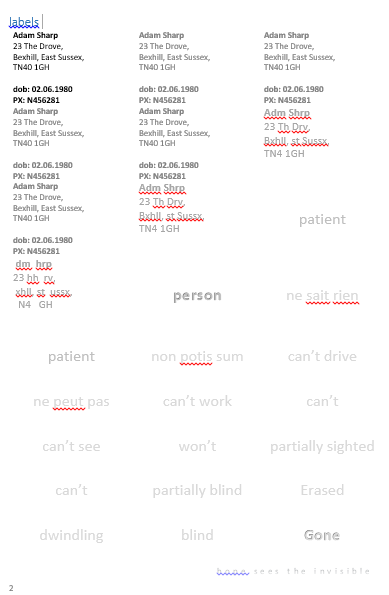
Patient. In some people’s eyes, Adam is also a patient. These people are part of the medical establishment. To them, he is patient, has to be other, the object of their care. Without this otherification, he is dangerous. Sometimes Adam feels like he is no longer a person. Is he a number, an object?

Practitioner. Optometrist, General Practitioner, Registrar, Consultant Neurosurgeon, Health Care Assistant (HCA), Nurse, Porter, Theatre Nurse, Technician, Ear, Nose and Throat (ENT) Specialist, Consultant Anaesthetist, Consultant Neurosurgeon (again),  Registrar (again), Senior Registrar, Have I lost you yet? Adam feels lost amongst this barrage of qualifications, acronyms and hierarchies. Name badges make little difference when you can’t see. Nurse, Nurse Practitioner, Health Care Assistant (HCA), Porter, Consultant Neurosurgeon (again), Registrar (again), Senior Registrar (again), HCA, Nurse, Occupational therapist, physiotherapist, psychiatrist, counsellor, general practitioner

Paper. This is a term paper, which I present to you for marking. Within this paper is a fictional paper written by a fictional doctor for a fantastical version of a journal for doctors, the British Medical Journal, and outwith this paper is a paper on blindness that would not stay unwritten. Each sheet you hold is paper, pulped wood, smeared with petrochemicals. Inkjet ink will smear with tears. Papers determine one’s identity: in this paper you may find out more about Adam, about the relationship between person and patient, between patients and practitioners, about me, the author, perhaps about yourself too.

Record. This paper is a record, but what is it recording? A record is a testimony: I write this on behalf of those who cannot write, speak, see. Memory, statement, report, in black on white. A written account of event(s). An achievement. Nothing in here is off the record, but it seeps out from the boundaries of the record; what I have read sprawls across this record, bleeding print, ideas that haemorrhage unstopped

Story. Story, first, was history. Now, story is, ‘a narrative of fictitious events, designed for entertainment’. Beyond definition, story is elusive. It dances between fact and fiction, fragments and the whole. It lives in the space between the sheets of paper, not just in the inked words on each page. It finds a space in your mind: story is nothing without mindspace. Story is not, if it is not read, not told. Story is personal, of a person, for people. See, speak, write, create a story, find a (happy) ending.

Tumour. There’s a tumour in Adam’s brain. As a sneak preview, I’ll let you know it is a pituitary adenoma. Does that mean much to you? Never mind. A few millimetres of errant tissue in Adam’s brain changes his behaviour, his choices, his life, his story. Meaning collapses for him. Mind you, when the story starts, he doesn’t yet know that he had a brain tumour. Bear that in mind.

See. Seeing: we see without thinking, we ‘look, behold; observe, perceive, understand; experience, visit, inspect’. I see: I follow what you are saying. I see: I have (a) vision. Also, See, ‘throne of a bishop, archbishop, or pope’ from Latin sedem ‘seat, throne, abode, temple,’ related to sedere ‘to sit’. I do not see, I am unseated.

Blind. Lacking sight? Unable to see? Blindness is seldom total lack of sight: most blind people have some residual vision. For them, life depends on exploring what is left. Think of blindness as part-sight, ‘now we see through a glass darkly’. The original sense of blind comes not from ‘sightless’ but ‘confused,’ underlying phrases like blind alley.

Sight. A thing seen, esp. of a striking or remarkable nature; a spectacle, a vision. The apocalypse. Something which calls forth contemptuous, horrified, or amused glances; a shocking, repulsive, or ridiculous spectacle. A show or display. Aspect, appearance, look. The perception or apprehension of something by means of the eyes; the presentation of a thing to the sense of vision. A view, a glimpse. Hold all these aspects of sight in your mind’s eye.

Loss. Something is missing, disappearing. At first imperceptibly, sight vanishes. Adam becomes aware of this slowly. Something in this eludes me, I cannot address it adequately in 6000 words. Practitioners lose perspective. Adam loses his personhood, loses half his field of vision, loses his …

… Pouvoir. (French) v. to be able to, can, may, might, n. power. From the Latin, potis sum, to be master of. Command, agency. Adam loses his ‘pouvoir’. Some is snatched from him, physiologically, some is taken by a system that disempowers him. Impuissant, he cannot see, so he cannot [………..].

… Savoir. (French) v. to know, to see, to be aware, to realise. n. knowledge, learning scholarship. from Latin sapere, (nominative sapiens), from PIE root *sep- (1) “to taste, perceive”. Homo sapiens – to be human? Knowledge, empathy, understanding all are needed to be a medical practitioner. Henry Marsh writes in Do No Harm, the voice of the practitioner for the purposes of this paper, ‘illnesses happen to patients, not to doctors.’ (p215) Knowledge, savoir, has a protective function. Adam is unseated, unsettled, uncertain, sans savoir.
Blindsided: instructions

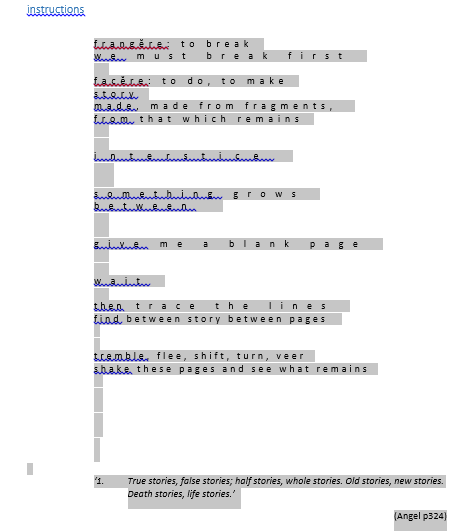
blindsided instructionsfrangĕre: to break

we must break first


facĕre: to do, to make

story

made, made from fragments,

from that which remains


interstice


something grows

between


give me a blank page


wait


then trace the lines

find between story between pages


tremble, flee, shift, turn, veer

shake these pages and see what remains


‘1.           True stories, false stories; half stories, whole stories. Old stories, new stories. Death stories, life stories.’

(Angel p324)

Blindsided: story in pieces

[Interstitial: n. Of an intervening space; esp. a relatively small or narrow space, between things or the parts of a body, of the minute spaces between the ultimate parts of matter. From the Latin, interstitium, space between]

[fragment: transf. and fig. a broken piece; a small detached portion, a part remaining or still preserved when the whole is lost or destroyed. from the Latin, frangĕre to break]


What images have burnt a trace in your mind when all else is forgotten? What stands when all else has fallen? What do we take with us when we flee?

Story burns, story stands. Story defines and identifies.

Anders Nilsen compiled Don’t go where I can’t follow, a story told in postcards, letters, cartoons, scraps torn from his jottings as his fiancée Cheryl was torn from him, from life. A camping trip, photos from when they visited France, then everything changes with the black and white text and sketches in The Hospital. After that, The Lake, the graphic story describes how Anders scatters Cheryl’s ashes where they had planned to marry. The book was first created as a memorial for friends and family. A relationship in ninety pages, this assemblage is as moving as thousands of words. It tells the story.


[fugitive adj. Apt or tending to flee; given to, or in the act of, running away. From the Latin, fugĕre to flee]


Story is elusive. Scattered snapshots, some burnt, blow across the pine needled forest floor. The house no longer stands, the people have been taken away, but a child hid in a gap in the wall, and now he is running too, so the story can go on … start … flickers, traces of memory, Fugitive Pieces, blurred memories tainted and torn by trauma, as in The Drowned City, the first section of Anne Michael’s novel. Chase the story, run it down, pursue it, consume it until it is part of you that only ends with death.


[fiction n. arbitrary invention, that which is fashioned or framed, counterfeiting, the action of ‘feigning’ or inventing imaginary incidents, existences; the species of literature which is concerned with the narration of imaginary events and the portraiture of imaginary characters. From the Latin fictiōn-em , noun of action, fingĕre to fashion or form]


Experimental stories glide into your mind, unseen, seep, creep, slide. Their presence eludes touch, but they are there, none-the-less. Expect no start, middle, end, no neat ravelling of threads to form a rope evenly over pages, chapters. When you close the book the rope is there, none-the-less.

In Katherine Angel’s Unmastered, A Book on Desire, Most Difficult to Tell a woman meets a man, has sex, conceives, has an abortion; ‘and then down, down, down, further and further I tumbled – Alice, pointy boots, tressed hair, topsy turvey into a tunnel of grief, into its numbing invisible embrace.’ (p238) Abortion reverberates through her life, through the white spaces in her book where something elusive starts to become present, something intangible, something that changes texture when you try to grip it.

‘5.           Years later I roamed, stunned, excited, through the Neues Museum in Berlin: rebuilt, restored; the archive of itself.

Its wounds preserved, lovingly rendered. Its memory on its skin.’

(p282)

Story emerges, unbidden, unbound.


[borrow: v. To take (a thing) on credit, on the understanding of returning it, or giving an equivalent; a thing recognized as being the property of another, to whom it is returnable.]


The pieces for this story are borrowed, appropriated, adapted. I learn through others. I take what I am given, and that which I am not given. I consume, devour other people’s stories to narrate my own.

Life’s events force story: we are compelled to tell our stories, of trauma, of change. Life is rich in complexity, messy, uncertain, relationships are tangled, and however much you want closure, a creative writer’s perfect plot, the script writer’s story arc, neat endings are unlikely. As Anne Carson writes, ‘The fragments of the Geryoneis itself read as if Stesichoros had composed a substantial narrative poem then ripped it to pieces and buried the pieces in a box with some song lyrics and lecture notes and scraps of meat … you can of course keep shaking the box.’(P6-7). That is life, that is writing about life.


[shake: v. to move quickly to and fro. To vibrate irregularly, tremble. To shiver, vibrate, flutter.intr. A poetical word for: To go, pass, move, journey; to flee, depart, in physical and non-physical senses.]

[unsettle: v. to force out of a settled condition; to deprive of fixity or quiet, not peaceful, not firmly established.]


Ref

  1. Marsh, Henry, Do No Harm, Stories of Life, Death and Brain Surgery (Phoenix, London, 2014)
  2. Jay, Martin, Downcast Eyes University of California Press 1994
  3. Nilsen, Anders,, Don’t go where I can’t follow (Drawn and Quarterly Quebec 2012)
  4. Michael, Anne, Fugitive Pieces (Bloomsbury, London, 1998)
  5. Carson, Anne, Autobiography of Red, (Jonathon Cape, London 1998)
  6. Angel, Katherine, Unmastered, A Book on Desire, Most Difficult to Tell (Allen Lane, London2012)
  7. Inspiration for word definitions derives from oed.com and etymonline.com accessed 3, 25, 28 March 2015 and Downcast Eyes (referenced above)

Blindsided: Introduction

‘My first sight on entering the consultation room was a Babel-like tower of multi-coloured folders containing the patient’s notes … a tower of sheets of paper, bursting out of dog-eared files, in which the recent relevant results have rarely been filed, and if they have been filed, have been filed in such a way that it is usually very difficult to find them.’

(Marsh 2014 p264)

Aspects of people’s stories can be found between the pages of a medical record, yet medical records are about the patient, not the person, for the practitioner. In much of what we have read this term the overall story is an accumulation, something found in the words on the page but also in between the words, between the pages, within different styles and formats, which makes me think of the way that a medical record works.

I want to unsettle conventional expectations of a medical record and use it as inspiration and as a place to contain poetry, prose and critical work, the scaffolding for the story of a person. Because of my background as an optometrist, I have written about sight loss, and explore issues of changing identity in relation to shifts related to sight loss. Sight loss unsettles the human experience in the same way that experimental writing can. It forces you to look in a different way, use different parts of your vision, your brain, your mind. Did you know that people with cortical visual impairment may not be able to ‘see’ an object, yet can still react to its presence?

Our senses are dominated by the visual, and as Martin Jay explains in Downcast Eyes (1994 p3), so is our language. Development of sight comes late to the foetus, and much only happens post birth. Since the industrial revolution our culture has shifted from oral to visual. In the imagination, our brains prioritise images over sounds and smells. The visual function takes a disproportionately large part of our brain, and it dominates this paper. Visual metaphors recur throughout. French creeps into this paper, as does Old English, as does Latin, language of medicine, in attempt to seize back jargon, to own language, on behalf of the patient, the person, my self.

With more space and time I would have included letters – a medical record is packed with referral letters between practitioners, post it notes, perhaps the person’s own notes, letters and thoughts. There is a further critical paper on sight loss in literature that I could not include due to constraints of space. This story spills out beyond these sheets.


Ref

  1. Marsh, Henry, Do No Harm, Stories of Life, Death and Brain Surgery (Phoenix, London, 2014)
  2. Jay, Martin, Downcast Eyes University of California Press 1994
  3. Nilsen, Anders,, Don’t go where I can’t follow (Drawn and Quarterly Quebec 2012)
  4. Michael, Anne, Fugitive Pieces (Bloomsbury, London, 1998)
  5. Carson, Anne, Autobiography of Red, (Jonathon Cape, London 1998)
  6. Angel, Katherine, Unmastered, A Book on Desire, Most Difficult to Tell (Allen Lane, London2012)
  7. Inspiration for word definitions derives from oed.com and etymonline.com accessed 3, 25, 28 March 2015 and Downcast Eyes (referenced above)

An’ here I go again on my own … Blindsided

blindsided coverIt’s term paper time. Experimental writing term paper time. Whatever comes up next on the blog should perhaps come with a warning. It’s written for a very small audience: people who are interested in sight and blindness along with experimental writing and the avant garde. I suspect I may be the only person in the centre of this Venn diagram … but I’ve been bitten hard by this one, it’s obsessing me, and I have so much more written than will fit in the term paper, and it’s all going to end up here …

watch this space

The title is Blindsided. Visual metaphors ripple through the work.

watch this space


Ref

quote: Derrida, Jaques, Droit De Regard (Les Impressions Nouvelles 2010)

Writing exercise: prompt from opening sentence

Head high, she swept out of the room. A second later, head even higher, she swept back in, snatched up the money and was gone again.
Tom glanced at Jane.
Jane shrugged.
Not my daughter – he could almost hear her thoughts. He sighed, raised his eyebrows, then stood.
“Right, let’s go. Kelly can meet us there when she’s ready.”
“If she wants, “Jane said.”Don’t make her.”
Don’t make things more difficult: more words they couldn’t say. He took Jane’s hand. “Is the Italian going to be all right?”
“It’s fine. I don’t feel that sick any more, in fact, I’m hungry!”


In the car on the way to the restaurant, he said, “Do you think she’ll …?” then he stopped.
“Meet us there? Buy her Mum a gift? Just give her time, Tom, she’s a good kid.”
“I know, but she’s angry right now.”
“It isn’t easy – new house, new step mum and now,” she glanced down, “new baby brother or sister.”
Tom half-smiled. “I heard her on the phone to a friend – apparently it’s gross!”
“The baby?”
“The thought that we’re having sex!”
Jane laughed at him. “I remember feeling like that when Mum got pregnant with Lucy, I was 12 then, not quite as old as Kelly.”

They were sitting near the window, menus open, drinks on the table, one space still vacant. The waiter lingered nearby and Tom looked at his watch. “We should order.”
“Give her a few minutes more,” Jane said. “Look, there she is!” Kelly was hurrying up the path to the restaurant, her arms full. “I think she’s got her Mum something too.”
Tom exhaled. Mothers’ Day might be going to work out.
Kelly burst into the restaurant, then thrust her package at Jane. “Happy Mothers’ Day.”
Jane flushed, then started to open her gift.
As she did, Kelly said, “Dad, I need more cash to get a gift for Mum!”

For the Book Analyst Writing Group

Nikki Young Writes
mumturnedmom

Exercise: Writing from Two Points of View 1

POV 1
She could see him, still in the hall, jacket on.
“Are you stopping, Daniel?” she called. “I’ll put the kettle on.”
She filled her hands with cups and saucers, the little set they found at that fair up past Whitby. It had been a bargain, even if it had been hard to keep it intact, two teenagers and a five year old in the house.
She glanced into the hall again. It was hard to match up the ruddy cheeked five year old, always trying to keep up with his brothers, with the six foot man who was hesitating out there. It wasn’t like Daniel to dither she thought as she placed the cups out carefully. She poured boiling water into the matching teapot, swirled it, tipped it out and refilled it, all the time fending off the fear that Daniel was hesitating for a reason.
‘Mum’s always together’, she’d heard one of the boys say, and she did keep it together, for them, but this year, last year, … she couldn’t word what had happened, still too raw. She ran the back of a finger under her eyelashes and glanced into the hall again. He seemed lost in thought and she was glad Tony was down in the garage.
She carried the pot and cups over to the table, laid them just so, appreciating the glow of the apricot china against the pale yellow Formica surface. She’d managed to keep that nice, no stains and not too many scratches. Daniel stepped forward, stopped, and then finally came into the kitchen.
“Mum. I need to tell you something.”

POV 2
He found her in the kitchen, had sought her out there where she was most her, most at home, most likely to accept. Dad was at work, he’d seen Sam head in to the hospital, knew Lucy was in nursery, the children in school. No reason to be interrupted, he turned off his phone. He’d had it on for months, it seemed, waiting for the next call, the next sign that the family was disintegrating. This time, he was choosing to deliver the blow, choosing to risk pushing everything a little further apart.
“Are you stopping in the hall, Daniel?” Mum called. “I’ll put the kettle on.”
“K.” He didn’t walk on, though, still waiting for some sign, some clarity. Sam had said it was fine. Fine: who needed approval? Dan sighed. He did, or he wouldn’t still be here in the hall, wouldn’t be hovering, waiting to tell, to ask. What happened if she said that she didn’t believe him, it couldn’t be true? Or worse, what if she believed him, and thought it was wrong. It didn’t fit with their faith, for sure. But maybe that was in head, there were gay Catholics, after all. He could almost hear Sam’s voice, saying, “You’re overthinking it.”
He shook himself, took a step forward. King of overthinking: that was Sam, not him. For a second he wished he’d brought Sam down too, for back up, to diffuse things if it looked like Mum was going to blow up. But she wasn’t like that, and he could do this. On his own.
“Mum. I need to tell you something.”

For the Book Analyst Writing Group

On Edward Hopper’s Automat

Automat 1

I slip off one glove, can’t touch the cup through leather, other skin, can’t feel the heat rise. I want my capillaries to dilate, my fingers to glow, something good, so I slip off my glove. Keep my face down, eyes gaze at coffee swirls, listen to the machines in background whirr. I wait.

He’s watching me, behind the counter. I’m alone, object of curiosity, objectified, warm air on my décolletage, wish I had a scarf, more fur, to shield, drape, hide me. Watch the patterns on the table swirl, white formica stained where he has wiped, cleaned, wiped again, white dance on white spins before my eyes in time with the whoosh and swirl of the drinks machine.

Silk on my skin, silk lining in my dress, my coat, no shield. I can’t go back, won’t go forward, not ready, not yet. Automat coffee, automat life, never tasting quite right, not like the fresh version everyone else is living, having, man behind the counter, going home to his kids, his wife, dinner on the table for him. Not me.

The coffee’s black, too bitter, cooling, can’t face the dregs, still hold the cup, hope of warmth fading. False life, false hope, but as long as I sit here, stay here, nothing will move on. I leave the last inch of coffee, a promise that there’s something more. Soon, I’ll leave, before he wipes the table one more time, before he stacks the chair. Soon, I’ll move my legs, one foot then the other, slip out from warmth to the cool night air, from limbo to action, the next step. But for now, I wait.

For the Book Analyst Facebook Group Writing Exercise

Review: Reasons to Stay Alive by Matt Haig


How do you write a traumatic life experience like depression? In the midst of it, picking up a pen and exploring your feelings is impossible.

Why do you write about depression? Because when you are deep within depression, it feels like no-one else in the history of time has ever felt like you … and once you have reached a place beyond depression, maybe you want to let others know about that elusive thing called hope.

When do you write about depression? When the drugs have started to work? When you feel like you’re living again? When there’s something new to say, or something only you can say, or the impulse to write it is too great and none of what you have written so far quite deals with the itch, the need, to stop other people hurting in the same way that you hurt?

I don’t think I’ve every written properly about being depressed. Much of it is a blur: the parts I remember will be hard to write and painful to share. Maybe, 13 years down the line, I haven’t yet reached that point.

Matt Haig experienced depression in his twenties, and now, around 15 years later, he had finally addressed it head on in Reasons to Stay Alive. It’s a beautiful book, pocket sized, white binding, orange inner covers, rainbows dancing across the paper outer. And inside, it’s beautiful too.

The writing takes the form of scattered pieces, part memoir, part lists, a few selected tweets, and the story builds between the short chapters and sections. I don’t always finish every book I start, for a range of reasons, but I finished this one. It’s honest. It’s compelling. And it doesn’t tell you not to be depressed.

Haig skilfully avoids the ‘them and us’ of most self help style books: he’s there, deep in the depression, he’s there again as his current self, offering help, proof of a future, and most importantly, hope. He does end with 40 bits of advice on ‘How to live’, but none of it is preachy, it’s all tempered by the fact that he admits he doesn’t always follow his own advice.

And to finish, here’s one bit from the book that I love …

Self-help

How to stop time: kiss.

How to travel in time: read.

How to escape time: music.

How to feel time: write.

How to release time: breathe.


Reasons to Stay Alive is an incredibly low priced £6.99 at time of writing. Well worth a read whether you have been depressed, or want to understand someone else a little bit better.