Afterwords: 70 Ps

Proper Prior Planning Prevents Piss Poor Performance

Product Price Place Promotion Physical People Process

Proper  Prior  Planning  Prevents  Piss  Poor  Prophylaxis

Prophylactic Prior Planning Prevents Pain & Powerlessness

Prophylaxis,                                         Power Performance

Prophylaxis,                                         Private Performance

Prophylaxis,                                         Pain Performance

Prophylaxis,                                         Political Performance

Prophylaxis,                                         Pissed Performance

Prophylaxis,                                         Priceless Performance

Prophylaxis,                             Power Performance

Prophylaxis,                 Poor Performance

Prophylaxis,     Performance

Prophylaxis Performs

Proper Prevention

Prior Promotion

Proper, Public

Pre-Planning

Preparation

Planning

Prevents

Private

Pain

Pain

Pain

My books aren’t my books anymore

My books           

My books sit on my shelf. I watch my books: they increase, flying to the flock by post, in bags. I see the ones that come by day, and I can’t turn them away. I invite them in, welcome them home. Some are slipping into my house at night, I think.

David won’t give books away. And I don’t help the problem. I write.

My books grow, yard by yard, author copies come by the dozen. Quick thrill, quickly sated, write some more.

I give books away to friends, my books, books I have bought, books I have been sent for review. But still they multiply.

I took two shopping bags of books to the charity shop the other day, after the shelves fell down. I still have more books than space.

Would I like the remaindered books? Where would I put a few hundred copies of a book that didn’t sell? In the basement, watch it float. Otherwise, will it burn? I don’t care. I am writing something new.

Non fiction

My books are other. Other amongst others, defined by the absence of fiction. No stories here. But there are stories, real stories. Is truth necessarily a not-fiction? When I write about someone’s experience I fictionalise it, with beginning, middle and end, even when the true story is still ongoing.

What is non fiction? Is it critical writing? A description of something real? Can it be poetry too? How can a whole genre be defined by it’s ‘non’ness, by something it’s not. And is it a genre anyway? There’s a story in there.

Non, no, n … an ancient sound, prefixed to so many words. No, not, lack, sham, from the Latin “not, by no means, not at all, not a,” from Old Latin noenum “not one”, ne oinom, from the Proto Indo European *ne “not” + *oi-no.

Fiction derives from the old French ficcion, something invented. Is writing based on research, invented? Is everything invented in some way? This is then based on the Latin, fictionem, a fashioning or feigning, from fingere, to shape, form, devise, to knead or form out of clay.

I mould words too, shape them, make them perform, change lives, yet my writing is non. Is it not fiction, a lack of fiction, sham fiction? My writing lacks. What does it lack?[1] Is the meaning of what I write as clear as I think? How do you interpret it? What do I lack?

Non academic

By definition, what I write is not academic. It takes what is written by academics, and that which is known by professionals and translates it for consumers. Your words: I consume them like a mother bird, pre-masticating mouthfuls of information, making it easy to digest. Diluting, simplifying. I lie, because nothing is ever as simple as I write.

Not mine             The books I write might not be mine.

From the moment I sign the contract, when I accept the cheque, (publishers still write cheques), when I pay it in, I need to check. Have I ensured that the words are still mine? In print, online? Pennies accrue each time my books are bought, borrowed, photocopied, all according to contract.

If you buy one of my books, it is yours. Do you need to read it for it to be yours? Probably not. It sits on your shelf, clearly one of your possessions, or on your Kindle exerting a lesser demand.

If someone translates what I write, whose words are they then? They are not the words I wrote … or are they?

Can a word ever be mine? How silly: words belong to everyone. What about two words together, or three or a whole sentence? If I create a combination of words that has never been used before … I search on Google, will that tell me ‘never’? … is that sentence mine? What if you say it, write it, photocopy it, paint it, print it? Whose words are they then?

What if I quote myself, or use a phrase I wrote last week, one that won’t stay unwritten, wants to be written again, I repeat? Does reiteration make it more mine? What about another print run, a second edition? No shift in ownership there, but I feel my ownership lessons if a book escapes online.

If I buy your book, it is still yours. Maybe when I run out of shelf space I should release my books into the wild, hoping that they will find their authors. Or are they, like graduates, reluctant to return home, too big, too full of new ideas, once I have read them?

My father read Swallows and Amazons to me as a child, then followed up with eleven more Ransomes. He collected a set of hardbacks for me, a set for my sister. I have those books and they are forever his. Ransome and my father intertwine: his voice, other-his words, my memory. On my shelf, in my house, a piece of myself as a child, and of my father then, and his childhood before, and his brother’s in there too. My books are other people.

My books are my children. I nurture them in early days, then let them go. I help them on their way, then sit back, always interested in their progress. My books are loose in the world, watch out.

When I die, my books will belong to my children, double edged legacy. What would you do with a house full of books, ownership transferring to you on death? They will inherit the words. Perhaps all their own books will be digital by then.

My books have power. They’ve changed my life. Read with caution, in case they do the same for you.


[1] My books are bound in facts. Can I reference creative work too? Is work critical only if referenced? This footnote intended to talk about lack. Please note its absence.
Jump cut: The Seven Ps


Rule 1: Powerful

As surgeon, you have power over me. I have power over my body, up to a point, after which my body has power over me. Do I wait and see if it will rule me kindly, a benign dictator, or do I pre-empt the battle. Combat zone: my breast. No-one announces the date battle will start. Shall we make plans to invade?

Rule 2: Private

My health is private, yet everyone wants to talk about it. Even Angelina was allowed to do it in private, only talking to the world once she was neatly sewn up, pert and perfect again. Would they feel they had the right to discuss it if I was having an abortion? Yet when I consider having my breasts cut off everyone has a view.

Rule 3: Painful

My pain is my own. If I think about this for long enough, I feel you cut into me, then I wait for my skin to heal, so that you can cut into me again. My skin cringes in anticipation. Your nurse was kind as she explained my options for pain relief. Of course, rather than embrace this particular pain, I could wait, but hope is no longer a viable option.

Rule 4: Performative

I can tell that you love to perform, and I’m grateful. One of us needs to be enthusiastic about this transaction. You explain the risks and benefits, hedged promises rolling off your tongue and over my head, a performance you’ve given many times before. I have forgotten my lines. ‘I de … I dis … I die …’ I stand there, hoping that the curtain will fall.

Rule 5: Political

It’s not just about me, he says. I’m fortunate to live in an age when I have the choice. (That’s when I end up reading Frances Burney.) Many women in many countries would give their … their what, I ask, their left breast? And their right one? In order to be able to choose their fate. The time and date at which battle commences. Ovaries too? Hell, take the lot!

Rule 6: Pissed

I’m pissed. So fucking angry, and who do I shout at? My mother, her mother? Generations of dead women who would have, who have given their lives for what I know. Take it back, I want to scream. I don’t want to know, I don’t want to choose.

Rule 7: Priceless

It comes down to money, doesn’t it? The whole fucking health care system, and because I have a job and insurance I have a choice, a choice that I don’t want. How much do you charge for bilateral prophylactic mastectomy, four nights in a private room, and another stay for reconstruction? How much do you get paid? Do you every wonder if you should have chosen another branch of medicine, another career? Or is it much clearer to you than it is to me, what good you do?

Scene. Re: building/ Re: fibulation, a promise


And that’s where we meet,

Eyes cast down.

Don’t look, don’t talk,

Don’t say my name.

Not out loud, as then you’ll know,

I’m betraying my mother,

My father,

My sisters.

Dare I ask …

You won’t be here,

Too American.


How do I explain?

It’s easy to know,

Knowledge bursts from the internet,

The print out in my bag.

I can see my tension in the way you sit,

But we’re not the same.

Cut me open again, I scream.

Close up. Setting, the hearth

No-one looks here, anyway.

The match sparks, tempting me.

I run my wrist over the flame,

First pass is painless, warming me.

It was the oven, an easy lie.

The flame grows, then fades.

I strike again, gold sparks loud,

In my silent home.

No-one sees here anyway,

So I hold it still a little longer.

Black hairs frizzle on my thigh.

No-one will see.

My skin, my choice, my pain.

Some people cut themselves, I’ve heard.

I couldn’t use a knife for that.

I light another match.

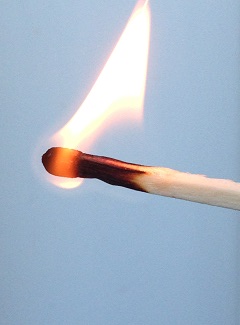
match on blue low res 2

Second edit: been cut before

I can’t let you see me.

And they were all celebrating while I bled.

Don’t look at me, not there.

We were dressed like dolls, toyed with,

Dark-skinned Barbies, just babies when,

Gems glittering, can’t distract from tears,

She made the cut.

Not down there, I know it’s why I came,

But please, not now.

They’re singing in the courtyard,

Shrill ululations echo, my scream unheard.

You’re not listening either,

My presence in your office permission enough.

I’m screaming, ‘Don’t touch,’ but nothing comes out.

Take off your dress, she said, and you say it too.

I can still smell the perfume, even as you disinfect your hands.

Lie down, she said. I lie, your bed an invitation, curtains drawn.

Open your legs like a good girl, she said.

You stand and wait for me to open my legs,

But I’ve been cut before.

I push down the skirt.

Not now, I say, I can’t. I’ll book again.

And on the street I can hear sirens screaming for me.

The bride price is high.

Your invoice arrives, despite my refusal.

Cutaway

I watch the blade,

The blade I chose,

And I watch the line,

The line in my control,

And it grows.

As blood spills, I release,

Anger that I had to choose,

Anger that it chose me,

Or did it?

Uncertainty bites,

And I slice again.

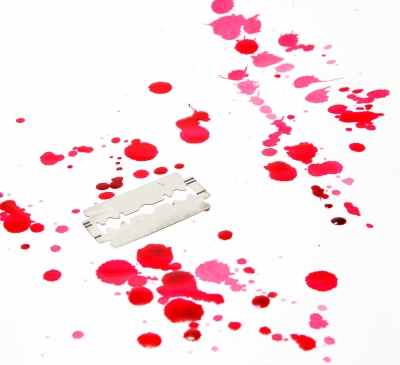
 Razor Blade With Drop Of Blood Stock Photo courtesy of freedigitalphotosdotnet

Unscene: Cross Cutting

They held me down,

I chose to go,

Blades are cheap,

Again and again they cut,

And I scream and I scream.

I don’t know how she did it,

Alert until she faints.

It’s so remote, no turning back,

We’re off to see your grandmother,

They lied.

I shouldn’t have read this,

Shouldn’t have thought …

And they act like they’re so happy.

You’ll be beautiful, they say.

A gory trip through YouTube, I can’t stop.

No-one talks about it, we all know.

It’s the not knowing that’s driven me here,

Or is it the knowing,

Knowing that my mother died?

Sometimes we don’t come back.

‘Why didn’t you just say no?’ he asks.

Like I knew, like I had any idea.

And if I’d known, and if I know,

And if I could see, would I still?

And will my girl? What daughter?

It’s easy for you, I spat, you don’t have to.

‘But if my wife, my sister, my daughter …’ He says.

What right have you, I say,

To try to walk in my shoes?

My breasts are still untried,

Should I wait?

It’s too late now, you hold me down.

I choose the knife. 

Unscene/On the cutting room floor

Establishing shot: To Frances Burney

I don’t know how she does it,

I don’t know how she did.

What choice?

Seven men,

And when the question rose,

Qui me tiendra ce sein?

She said, I will,

She chose.


And like today, my choice laid plain,

When I look back,

Would I make it again?


I don’t know how you did it

And I walk towards the knife,

Steel glitters.

Strange perverted choice.

Cut me! I call.

Slice me left and right.

(And all the world watches Angelina Jolie, seeming unscathed.)

And the man, it’s always a man,

Takes up the knife.

Strange courage, cut that which might be good.

His risk, and mine,

Partners in violation.

What good could they have done?

And what harm?

Death and life in his plastic hand.


I don’t know how you do it.

Nor do I,

Each morning as I watch my fingers crawl,

A little higher up the wall.

Did I make the right choice?

You chose.

They never knew,

What grew inside you.

Who can tell?

I’ll never know if I share my sister’s fate.

(it’s ninety-ten)

And still I chose.

What choice had you?

Half way

Mid way to seventy six.

I have it all (I did).

On the up, once,

Now down,

Until I’m stripped.

(You were taken from me.)

Pared, unwilling,

Slices, thin and thin, repeat,

Each bloody cut.

I shrink.


Half way through, I stop,

Stop, stop.

A moment on the peak,

Should be joyous,

Breathless awe.

(You should be there).


My story’s mundane, so many others,

Yet we each stand alone.


And the view from here,

I look both ways.

Rear view: a precipice.

Not one step forward,

I stay,

The flame shakes.


Still flayed, red raw,

I won’t go on.

(No way back.)

What I see ahead is smoke,

No mirrors for false comfort.

(I can’t look back.)

My head drops.

How long can I stand here,

Alone?