Still wrangling with form …
Still wrangling with form …
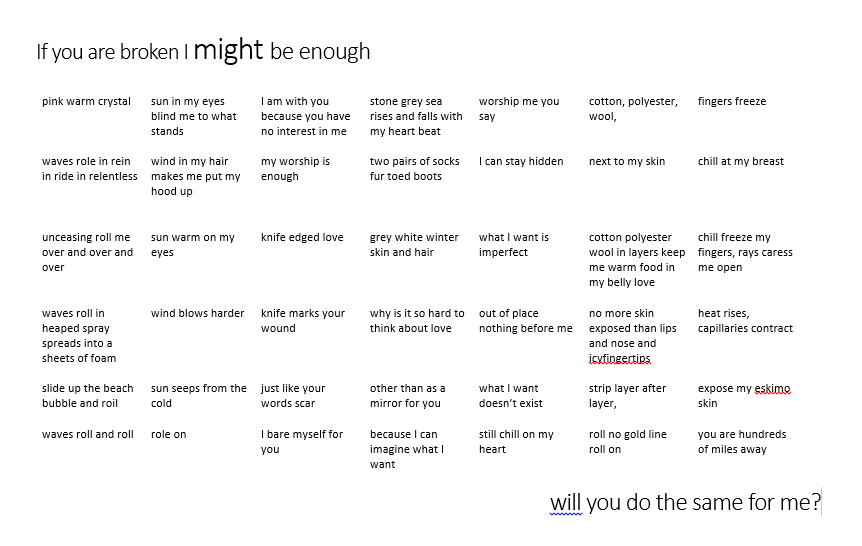
This is an evolution from my notes from last weeks writing exercise, and I need some opinions! Is this better with more punctuation, as in the version here, or less … see below.
Version 1
If you are broken I might be good enough
Pink-warm crystal next to my skin. Stone grey sea rises and falls with my heart beat. Sun in my eyes blind me to what stands. Chill freeze my fingers, can’t write. Rays caress me open. No gold. Why is it so hard to think about love? Heat rises from my fingertips, capillaries contract. Cotton polyester wool in layers keep me warm, food in my belly, love. Two pairs of socks, fur toed boots. Waves roll in, heaped spray spreads into a sheets of foam. Slide up the beach, bubble and roil, knife edged love. No more skin exposed than lips and nose and icyfingertips.
Waves role in rein in ride in relentless unceasing roll me over and over and over and I am with you because you have no interest in me other than as a mirror for you. I can stay hidden. Worship me, you say, and my worship is enough.
Wind in my hair makes me put my hood up, just like your words scar, knife marks yours wound chill at my breast. What I want doesn’t exist, what I want is imperfect because I can imagine what I want.
Waves roll and roll, sun seeps from the cold. Wind blows harder, fingers freeze. Still chill on my heart, sun warm on my eyes and you are hundreds of miles away.
Expose my eskimo skin, grey white winter skin and hair, strip layer after layer, cotton, polyester, wool. Bare myself for you. Will you do the same for me?
Out of place, nothing before me, line roll on.
Role on.
Roll.
Version 2
If you are broken I might be good enough
pink warm crystal next to my skin stone grey sea rises and falls with my heart beat
sun in my eyes blind me to what stands chill freeze my fingers can’t write rays caress me open
no gold why is it so hard to think about love
heat rises from my fingertips capillaries contract cotton polyester wool in layers keep me warm food in my belly love
two pairs of socks fur toed boots
waves roll in heaped spray spreads into a sheets of foam slide up the beach bubble and roil knife edged love no more skin exposed than lips and nose and icyfingertips
waves role in rein in ride in relentless unceasing roll me over and over and over
and I am with you because you have no interest in me other than as a mirror for you I can stay hidden worship me you say and my worship is enough
wind in my hair makes me put my hood up just like your words scar knife marks yours wound chill at my breast
what I want doesn’t exist what I want is imperfect because I can imagine what I want
waves roll and roll sun seeps from the cold wind blows harder fingers freeze still chill on my heart sun warm on my eyes and you are hundreds of miles away
expose my eskimo skin grey white winter skin and hair strip layer after layer, cotton, polyester, wool, bare myself for you will you do the same for me
out of place nothing before me line roll on
role on
roll
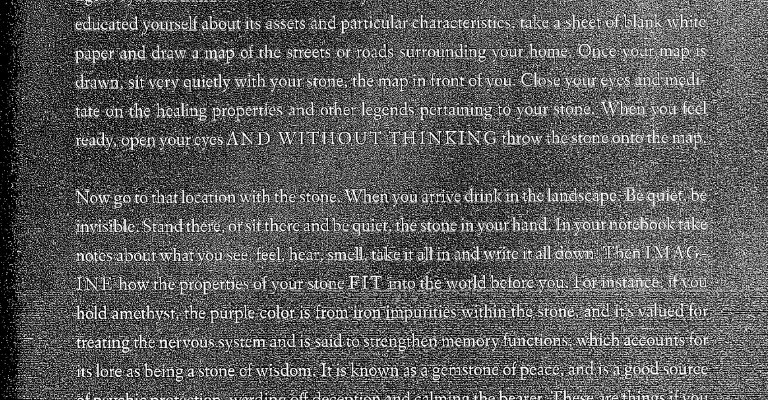
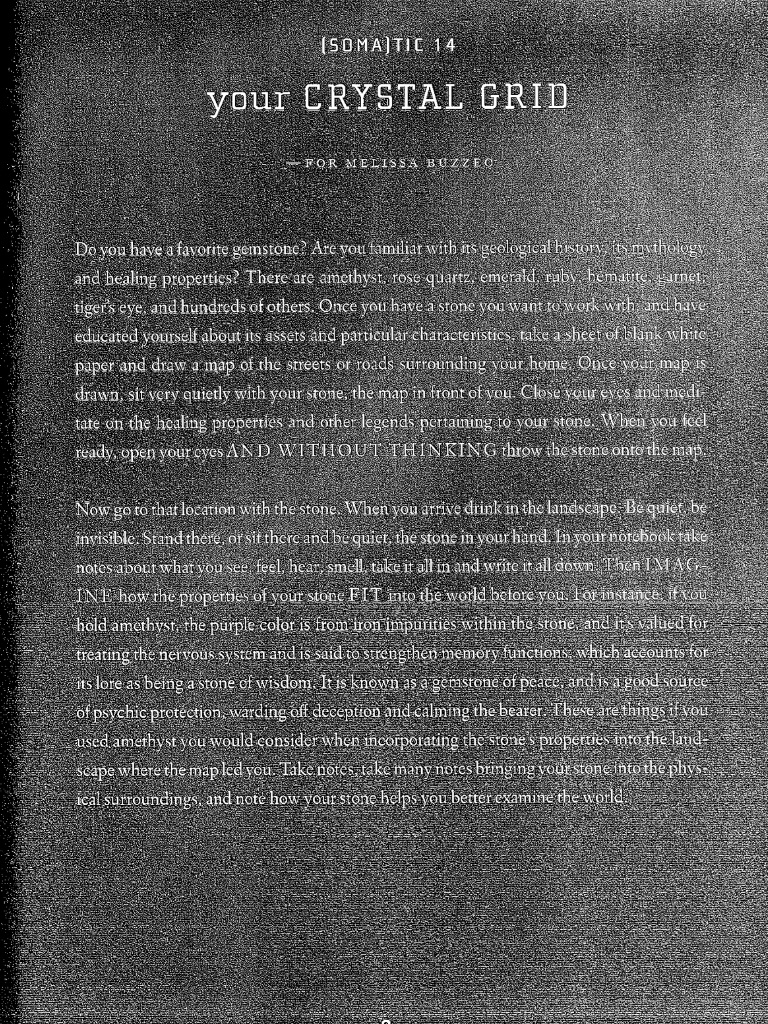
This week is about doing an exercise from CA Conrad’s A Beautiful Marsupial Afternoon: New (Soma)tics. This is a beautiful book, mixing poems and ‘exercises’, most of which are designed to take you out of sitting in front of the laptop or at a desk. Instead why not try making soup and writing with your hand in your soup? Or writing with a penny in your mouth? The Soma(tics) are about feeling and writing, writing and feeling, finding my body, coalescing the divine and the nervous system, all of which is explained better in the introduction to the book which I think you should be able to read via Amazon’s Look Inside.
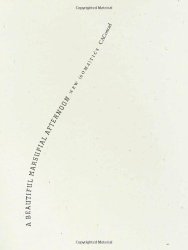 The image, top right, outlines the exercise I picked, taking a crystal, throwing it on a hand drawn map, and going to where it falls to write. This is an initial draft pulled from the notes I wrote while out. I’ve consciously not punctuated or added capitals because I’m fed up with Word capitalising for me. I may come back and punctuate later but this flow seemed to fit with the thoughts and notes I created:
If you are broken I might be good enough
pink warm crystal next to my skin stone grey sea rises and falls with my heart beat
sun in my eyes blind me to what stands chill freeze my fingers can’t write rays caress me open
no gold why is it so hard to think about love
heat rises from my fingertips capillaries contract cotton polyester wool in layers keep me warm food in my belly love
two pairs of socks fur toed boots
waves roll in heaped spray spreads into a sheets of foam slide up the beach bubble and roil knife edged love no more skin exposed than lips and nose and icyfingertips
waves role in rein in ride in relentless unceasing roll me over and over and over
and I am with you because you have no interest in me other than as a mirror for you I can stay hidden worship me you say and my worship is enough
wind in my hair makes me put my hood up just like your words scar knife marks yours wound chill at my breast
what I want doesn’t exist what I want is imperfect because I can imagine what I want
waves roll and roll sun seeps from the cold wind blows harder fingers freeze still chill on my heart sun warm on my eyes and you are hundreds of miles away
expose my eskimo skin grey white winter skin and hair strip layer after layer, cotton, polyester, wool, bare myself for you will you do the same for me
out of place nothing before me line roll on
role on
rhole on
rowl on
worl on
wowl on
ole on
roll
I’m at the top of the stairs, hand on the cold wooden bannisters, chill air swirling round my legs. Long way down. On my own, away from home, no memorylayers here. Overview, over heads, flowers on green grass play beneath my bare feet. Wriggling toes dart from under my night dress.
Adults downstairs, outside, elsewhere. I don’t know why I’m here, so much I don’t know. Grannie loves me, that I know, safe here.
“She’s had it.”
“Lovely.”
“Another girl,” drifts up the stairs.
Dig my toes in the carpet, listen. Shouldn’t be there, where’s mum, grip the wood and wait for someone to notice me as the smell of toast rises.
Slip three years, another house, another bannister, white paint, top of the stairs legs furled against the cold, mix of perfume, wine and smoke rises, dinner party, we tasted the chocolate mousse.
Louise and I, top of the stairs, shouldn’t be there, carpet rough against my thighs, heap of fur coats on the hall, clatter of silver, of glass.
“We have to hide if someone comes out,” I tell her, skirl of white nightdresses as we giggle our way back to our room. Heavy footsteps on the stairs, “Go to sleep, girls, go to sleep.”
Too tall now, no bannisters in this flat, no chance to look down on the adult world because I’m in there, part of it, and I miss being small, loss of secrets, loss of looking on, curled up in the back of the car, stories in my head, night darkening as my father drives us home.
For the Book Analyst writing group challenge
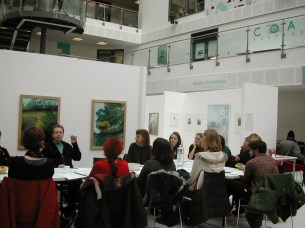 More explanation. I went to a creative writing workshop based on the exhibition, Observations. It was run by Tempo arts and facilitated by Ian Monk, a member of the Oulipo group. (See last week’s post if you want to know more about Oulipo and why I’m interested in it.)
Ian asked us to write 3 lines, in the centre of the page, inspired by one picture from the exhibition, in haiku form, 5 syllables, 7 syllables, 5 syllables. He then asked us to expand, up and down, as if we were looking outside the frame of the picture.
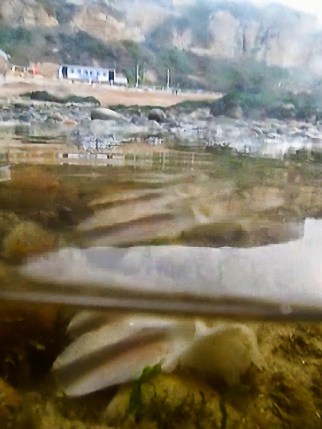
in the beginning
sun on water, salt and earth
protozoa crawl
oil slick skin keep me safe whole
from water we come
and from water we are made
and in that moment
waves stull, black ice crystals form
eyes mouth full. I drown
gasp inhale brine my lungs
surface. Air once more
exhausting oscillation
a choice. My choice? No.
I’m drawn to where I came from
body dissipates
At this point we were asked to leave our poems on the table and walk round and take 3 lines from someone else’s poem:

Phoenix In Fire Background Photo by fotographic1980 via http://www.freedigitalphotos.net/
Crack. Dark. Swamp leaf earth mould egg
a dragon is born
small spark wavers wavers falls
le mer violant
exhales mille drunken kisses
smelting sea to gold
en or I watch him arise
phoenix wing spread burns
destruction dragonified
This was a useful exercise following on from the first experimental writing workshop, again forcing me to discard my habitual choice of words to fit a constraint.

I don’t normally feel the need to explain my writing, and would rather let it stand by myself. This term, however, we’re doing an experimental writing workshop so …
This week’s exercise is based on Oulipo, a group of writers, originating in France who write ‘with constraints’ and impose rules on what they do. What’s the point? Well, just in doing these exercises, I’ve found my vocab challenged and I’ve been pushed out of using phrases and structures that I didn’t realise i was stuck in. See what you think …
A Belle Absente – a love poem, where you omit the letters of the name of the beloved. In this one, the first letter is omitted from all the words in the first line, the second from the second line and so on. I also entirely omit z.
Belle absente – no z
No hurry, we grow near, contrived ex-juncture, back-bound flame, leap the oblique.
No speed, a joyful glimpse of you enough, you bring me, wing me, my calyx, manqué, lack-driven.
No rush, pack foot forward, our ghost visits, filling my body, mixing my quick spirit, jostling my mind.
We join, step by slow-paced step like we are at no time apart, axel spinning, our faded quest near done.
We meet, quest-vexed, joke, hug, fall, candy touch, you pour yourself over my body.
In gaps, in want, in sound-lack, box-quick form of you, my Hajj, your vow, our void.
 A circuit – a poem which can be read in different directions. The most amazing version of this is the book, Hundred Thousand Billion poems.
This is a simple ‘table’ – read along the lines or down the columns.
Asking I open my mouth I hold out my hands
Choosing Head first I follow my heart
Listening I use my ears Blood circulates, I breathe
Writing From eye to brain From head to heart to hand to pen
Publishing I make my mark I fall.
There’s still plenty of work to do on these two poems, but I can already see how the constraints challenge my vocabulary, and force me to find fresh ways to describe an experience.
Part 1 is here
She feels sick as she wipes the counter. Nausea took up residence within days of him being home, and however much she sprays, wipes, polishes, she can’t get rid of the smell in the kitchen.
“Slow down,” he says, “take deep breaths, relax.” They’d taught him all that, in there. She still can’t name the place where he’d been and a tsunami of shame overcomes her and washes her away from the friends they had, before. She is adrift and he is no lifeline.
He’s taken to walking round the grounds since he came home, makes her come too, and almost every day they spend an hour or two, making a new path as they tread the perimeter. Tall pines overshadow the north side of the property, and she shivers as they walk there. He knows that now, notices like he never would have done, and he makes sure to take her arm. Further on, they turn a corner and the view opens up in front of them, smooth green lawns with a covering of frost to the right, chilled brown fields to the left.
“It looks bigger now the fields are bare,” he says, “but I like it better in the spring. Won’t be long now before we start to see green again.”
She pokes at the frozen autumn leaves with her Hunters. At first she’d insisted on washing them after every walk until any trace of leaf and earth was gone and the boots were shop-fresh again, but he puts his hand on hers, warm flesh, stopping her turning the cold metal tap. “Come inside,” he says. “We can make hot chocolate. They’ll only get dirty again tomorrow.” So now, the boots are mud-caked in layers. She shudders as she put them on, but he is right, and his smile as she steps out in them makes it worthwhile.
It doesn’t stop her cleaning, though. Somehow she has to get rid of the stale smell in the kitchen. Something is rotting, she’s sure. She empties the fridge, wipes inside, uses bicarbonate of soda, and still the stench grabs at her throat. He pulls her away in the end. “It’s fine, there’s no smell,” he says, but that only makes her wonder if she is insane, or him. And she remembers clearing away the blood, the broken glass, and knows that back then it was him.
The house looks better now, she thinks as she carried the drinks tray through to the living room, places it on the table, adjusts it so the edges are parallel, each glass of G&T centred, each lemon slice the same. No scars visible here, and when he is dressed he looks fine too, as he sips his drink. She takes one mouthful, then, nauseated, leaves the rest.
In bed, each night, she steals glances as he strips his shirt off. He keeps his back to her, but there are mirrors all down the wall. Livid red lines down his stomach, his arms, reflect, stark against the white of his skin, the walls, the sheets, the curtains. No amount of cleaning will erase those lines, and he always turns off the light before climbing into bed and pulling her close.
She starts to decorate the Christmas tree, means to do it by herself, but he comes in as she is half way through. He picks up a bauble, sticks it on a branch, then grabs a strand of tinsel and wraps it round her. He pulls her to him, steals a kiss, and she finds a smile fighting its way out.
“Not there,” she says as she moves that first bauble, but he keeps putting them on, wrong on purpose, she thinks, and it looks so higgledy-piggledy that she giggles, and the giggle becomes a laugh and they both fall onto the sofa, surrounded by tinsel.
She leaves the tree like that: it isn’t magazine-feature perfect, like it had been in previous years, but perfect didn’t work, and she is ready to try something new.
She sips her Earl Grey, one thin slice of lemon, the only thing she wants to drink now. The early-morning smell of coffee leaves her nauseated, toast turns her stomach, and she reluctantly has to hand over cooking to him.
“I’ll clean the kitchen afterwards,” she says, drawn to the splashes on the chrome.
He frowns. “We should get you checked out. You can’t eat less, you’ll fade away.”
“I’m fine,” she says, and she focusses all her efforts on clearing her plate at dinner that night.
“It’s delicious,” she says, but the venison battles inside her stomach and she has to leave the room before dessert.
He still has to see the therapist every morning, and their days find some sort of routine. She sits and waits in on a bench, not far from the car park while he talks. When he’s done, he suggests coffee. Her stomach churns. “I can’t,” she says. He frowns, and she swallows down bile.
The second week, he asks again if she is okay. She turns away and says, “I’m fine.” She can’t tell him that the months in the hospital have changed nothing, not who he is, nor who she is, nor what cannot be. She can’t explain that every moment he isn’t alongside her she wonders whether she will find him again, guts exposed and veins spilt open. It is months since it happened.
“You don’t need to fret,” he says too often, while for her the spine of every day is worry.
They take the decorations down. She cleans. “It’s spring cleaning,” she says when he suggests she takes a break.
“It’s a bit early for spring,” he says and persuades her out into the grounds to hunt for green shoots. They find one clump of snowdrops, tiny spikes forcing their way through chilled earth.
“See! It is spring,” she says, taking his hand. “I can spring clean.”
His face is serious as he asks, “Are you still feeling sick? Is there still a smell in the kitchen?”
She shudders, and nods.
“Will you see a doctor?”
Out there, where green shoots are growing, his hand warm in hers, she isn’t so afraid for him, but the nausea still roils in her belly.
“I don’t need to. He’ll only say I’m anxious.”
She is sick the next morning, and the one after that.
He doesn’t suggest coffee when he comes out from seeing the therapist that day. “I’ve made an appointment,” he says, phone in his hand, “Three o’clock today. Harley Street.”
She is silent, wanting to argue as she always does that waiting in a room full of sick people will make anyone sick, but in Harley Street there won’t be a room full of people, they won’t have to wait. He is serious about this appointment, and because he wants it like he hasn’t wanted anything since he came home, she goes.
The carpet is soft under her feet, her leather soled silver pumps let feel every undulation in the deep pile. It is so long since they have been to an appointment that is about her, not him, she doesn’t know what to do, to say, so she lets him say her name for her, lets him lead her to a chair.
“You look exhausted,” he says, then he is silent too.
There is a taste in her mouth, like something has died, and it has been like that for weeks now. She cleans her teeth as much as she cleans the house, but he hasn’t picked up on that. Silence fills the room, broken by the tap of long manicured nails on a keyboard. She can feel her eyelashes brush her cheeks as she blinks, feel the silk camisole against her back, the straps of her bra against her skin, her breasts soft, tender, somehow fuller, while her skirt feels a little low, too loose now.
“She’s been feeling sick for weeks,” he says when they see the doctor. “She’s hardly eating.”
“I’m fine,” comes out, but so quietly that even she struggles to hear it.
“I’ve put her through a lot this year,” he says.
The doctor probes her, takes blood, asks her to pee in a cup. She takes her time in the shiny stark white bathroom, doesn’t want to return to be examined, exposed. But in the toilet, hovering over the toilet as her thighs shake, hand between her legs, waiting to catch the urine, she wonders if he worries about her too when she leaves the room, so she pulls up her tights, screws the lid on the pot and returns.
“It won’t take a moment,” the doctor says. “I’ll have some tea brought through.”
“Earl Grey,” he says, “she drinks it with lemon.”
She wants to say I’m fine, I can speak for myself, but when the tray comes in she wants to check the cups are clean, doesn’t want to drink from a cup that has touched someone else’s lips, and maybe she isn’t fine.
“Have you been trying for a baby?” the doctor asks when the nurse returns with a sheaf of forms.
He is silent, this time, and she grips his hand.
“We can’t,” she says. “I can’t. That’s why …” She falters. Everything was perfect, they’d had money, time, a beautiful home, but he’d wanted the one thing she couldn’t give him.
“It’s fine,” he says, face turned to her, wrinkles round his eyes, grey hairs at his temples that hadn’t been there a year ago. “It can’t be helped. I’ve talked to the therapist about it. I’m fine. ” He turns to the doctor. “We’re fine.”
“You’re pregnant,” the doctor says.
Bile rises in her mouth. She swallows. “I can’t. They said … I can’t.”
The doctor holds out the form. “We can arrange a scan and see how far along you are.”
He’s looking at her again, the wrinkles round his eyes have changed shape. There’s an upturn to his his mouth and tears spark as he says, “A baby. Our baby”
She tries to smile back, but hairs rise on the nape of her neck. Discussion about antenatal vitamins passes over her as she thinks about the thing growing inside her.
When they return home she goes through to the gardens, and the snowdrops have come into bud.
TBC
(Part 1 is here)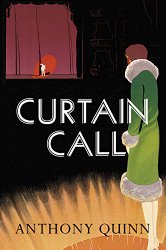 I like detective stories, and I’d say that Curtain Call, set in 1930s London, is a better than average book in the genre. It starts off with four chapters from the points of view of the four main characters, which perhaps isn’t the easiest lead in, but Quinn creates compelling people who’s stories and links I wanted to unravel.
The book follows actress Nina Land, fading older reviewer Jimmy Erskine, his assistant Tom Tunner and society portrait artist Stephen. They are drawn together with Madeline, good girl turned prostitute who is threatened by a serial killer whose face she has seen.
The book creates a lively setting, taking you deep into London theatre society while avoiding too many stereotypes. Relationships develop and are smashed apart as the plot builds to a climax. Not everyone gets a happy ending, nor perhaps the ending they deserve, but the killer is caught in a dramatic finale.
A satisfying read.
Theft I didn’t notice at first, still towelling my hair, feet sticking to the lino, which was never quite clean. Then, flash of image, what I’d left, thin beige duvet, should be a splash of blue green from the phone case, bought in New York before I left. Gone. Heart racing I kneel, scan under the bed, stand, spin, is someone still there? Still only wearing a towel, I pull it closer. Gone. Definitely gone. I ferret in my cupboard, find my bag, my money, my passport. Still there, just the phone. One careless moment. The door had been locked. Had it? I should have been more careful, should have had it with me. How? I was in the shower, only a moment. They didn’t get my passport. It was only a phone. Still. Violated. In my room. Not mine, not really, just for now, stupid hostel, should have had better locks. I shouldn’t have left my phone on the bed. Downstairs, my words falter, my French never feels enough, my Arabic is almost non-existent, but he understands, nods, like it had happened many times before. He shoves a piece of paper across the counter to me. “Allez visiter le poste de police.” He turned back to the computer, job done. I gather myself, my bag across my front, passport, money all tucked away. This time. I check for my phone, even though I know it’s gone, then set off. I pull my coat closer as I get on the train, fix my gaze on the white walls, blue metal work, white and brick houses, which soon give way to the long rail road across the salt lake. The chimneys are still spewing out smoke, a constant in every journey I make to the city. As we pull into Tunis Marin I glimpse the usual flock of greying winter flamingos. I should never have chosen that hostel, cheaper in some sprawling suburb. I’m too white, too tall, too ginger, too obviously a target even amongst all the other transients who stay there. It’s got better the longer I’ve stayed, better, not never good. I’m never relaxed on the way to work, and when I find somewhere else to stay … I’ll try harder, ask the other teachers at the language school. Someone must know of a place where a single woman could …but maybe that’s it, maybe I’ll never feel safe here. As I stride through the crowds on their way to work I glance down at the paper, damp from my hand. “Want carpet? Come and see Exhibition, last day today.” I don’t make eye contact, “Non,” shake my head, move on, navigate the maze. I know where to go now, which route through the medina for bread, for juice, how to avoid the stench and slaughter of the meat market. I thought I could find a way to avoid the touts too, but now I know that will never happen as long as I am who I am. The police station is dusty, crowded. Security checks, carried out by an imposing man, almost my height, make me feel like the thief. The constant presence of machine guns exposes something in me. The policewoman who deals with me is beautiful, serene in the chaos. I can explain the theft, drag the right words to the surface, jumble them together. She shakes her head, her English better than my French as she says, “You won’t get it back.” We fill in the forms, I leave, carry on my way to school. There’s a phone there, I can make a call, see if my insurance will cover it. Something in me bucks against this futile act, wishes for enough money that it didn’t matter, that I didn’t need to negotiate with insurers, stay in the crappy hostel, work in a country where freedom is growing, yet I have less freedom than I’ve ever known. I pause at the gate of the school, wave of voices from the open windows draw me in. I’m late, my class is waiting. Habib meets my eye, nods, opens the gate. I stand there, and for a moment I’ve walked on, packed my bags, … but I know the wrangles involved in leaving the country. I exhale, turn, and walk through the gate. It’s only three days later when I hear. Arnaud is always the first with the gossip, his words spilling in French and English, we’re used to that strange polyglot in the staffroom here. “Suicide Bomber” comes out clearly amongst the muddle. Three policemen, dead. “She went in to report a stolen wallet, but she had a bomb under her coat.” And I wonder how she got in, why she did it, what balanced the sacrifice? I remember the faces of the policemen, the impassive man who did the security check, the beautiful woman, her face sombre and resigned as she dealt with my report, the shorter man, a little stout, who held the door for me on the way out. And that evening, I stay on at the school and use the internet to look at the price of a ticket home.
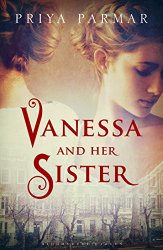 What would it be like to live with someone like Virginia Woolf? Precociously talented, prone to tip over the edge into insanity, the Stephen family and Vanessa Stephen in particular were driven by Virginia.
In Vanessa and Her Sister
The book is written in letters and diary entries, mainly from and by Vanessa, but interspersed with postcards between Lytton Strachey and Leonard Woolf, plus the occasional telegram and letter from the States from Roger Fry to his wife and his mother. Without knowing what happens, these postcards, telegrams and letters seem slightly random: perhaps we are all expected to know the tangled love affairs of the Bloomsbury group in advance.
I’ve written a lot about Woolf in the last 18 months, and have mainly read literary criticism of her work, her diaries, and historical comments on her life. It was interesting to get this fictionalised version which very much brought to life events such as what happened to Thoby, the family trips to Europe and Cornwall, and life in Bloomsbury and Sussex. I think Parmar captured the atmosphere very well, with barely an error.
I’m fascinated by the thin line between fact and fiction, and want to learn more about writing other people’s lives. This sort of fictionalised account has to be firmly rooted in fact or it will lay itself open to criticism, but some of the joy of writing fiction must be the ability to imagine and conjure thoughts and motives. Worth a read if you are a fan of the Bloomsbury Group, and you too can feed your imagination.
 38to39