Review: William Shaw’s A Book of Scars


I love detective fiction. It’s sometimes a guilty pleasure as I tuck into an old favourite, but sometimes it’s a more challenging read, and that’s the case for A Book of Scars. This is the third in William Shaw’s Breen and Tozer series, and it’s worth starting with the first book, A Song from Dead Lips (Breen and Tozer Book 1) as the plot builds cleverly over the trilogy, even as each book stands alone.

The series starts in 1968 and moves to 1969 with a recognisable London setting, and characters that are spread across the divide that split teenagers from the older generation, those for whom everything was ‘Fab’ from those who still wore suits and polished shoes.

Sergeant Cathal Breen is in the latter group and he is forced out of his comfort zone by the death of his father in the first book, and throughout the series by  Helen Tozer who is the first female trainee CID officer in Breen’s unit.

A series of murders drive the detective part of each book: these are as well researched as the historical details. There are some fascinating elements that link some of the stories to Africa too, focussing particularly on events in Biafra at the time, and Kenya some years earlier, both of which link in to the cases that Breen and Tozer are working on.

Throughout the series Breen and Tozer’s relationship develops. There are no hearts and flowers and the end of the series sees their relationship at a stage that is perhaps of the time, with the right amount of human interest for a crime novel. And the mystery that is set at the start of book one, what happened to Helen Tozer’s sister Alexandra, grows in significance and is resolved by the end of the third book. Overall this is a great series of books, well written with good characterisation.

Brighton Festival: Jeanette Winterson and more

I picked up the Brighton Festival programme at the station a few months back and was overwhelmed with the range of events on offer. I’m doing a MA in Critical and Creative Writing and Ali Smith had already been in to speak, so I was interested to see what she would include in the month’s events, and I wasn’t disappointed. At all! My only challenge was to choose what to see.
‘Boldness in the Face of a Blank Page’ was the title of Jeanette Winterson’s talk, and it wa great to be able to take up a friend’s spare ticket as I’d missed out on buying my own – tickets sold really quickly. The talk took place the night of the general election, and Winterson had a great rapport with the left leaning audience who’s main concerns were ‘Labour or green?’ She started by explaining how her talk had little to do with the title, which she had come up with when called by the festival co-ordinators! Despite that disclaimer, her talk was full of boldness and took us through her personal slant on writing. She is a sparky well-informed speaker, mixing quotes from her own work with others. A quote that stuck with me ties in with my own research on story:

‘Of course that is not the whole story, but that is the way with stories; we make them what we will. It’s a way of explaining the universe while leaving the universe unexplained, it’s a way of keeping it all alive, not boxing it into time. Everyone who tells a story tells it differently, just to remind us that everybody sees it differently. Some people say there are true things to be found, some people say all kinds of things can be proved. I don’t believe them. The only thing for certain is how complicated it all is, like string full of knots. It’s all there but hard to find the beginning and impossible to fathom the end. The best you can do is admire the cat’s cradle and maybe knot it up a bit more.’

Jeanette Winterson Oranges are Not the Only Fruit P119 Vantage London 2014

 So, the talk was great, the Dome was packed and the audience asked relevant and mostly interesting questions: in a lot of ways it was very typical of the whole Brighton Festival experience. Brighton is a unique city, with a mix of artists and tech-specialists, right on the coast. Walk through the city and you’ll see amazing fashion and style too, street performers, and posters for the hundreds of events that formed part of the Brighton Festival Fringe. As well as the Winterson talk, there were other literary events, lots of theatre and book readings for adults and kids, events ranging from Jaqueline Wilson and Noggin the Nog to Ali Smith’s own talk. And somehow in there, Smith wove themes such as Art and Nature, and Crossing Places, looking at the crossover between art forms, to create a wonderful month of events that drew together the best of Brighton and beyond.

Blindsided: Symptoms

Symptoms

  • Tredness
  • Unexplaned mood changes
  • Muscle weakness
  • Optc feld loss
  • Unexplaned lack of lbdo
  • Reduced tolerance to cold

The next secton helps explan what tests and scans may be needed to learn more about the cause of the symptoms.

Blindsided: Waiting, or Meet Dr Google

What did the doctor say?

i don’t know. He’s writing a letter. i … i’m going to bed.

Tonight i shall search for Causes of sight loss

No, i’m fine. i’m sure I’ll hear soon.

Tonight i shall search for Causes of visual field loss

 Are you getting up, Adam?

No.

Tonight i shall search for Temporal field loss

 Do you want to talk about this?

No.

Tonight i shall search for Pituitary tumour field loss

i … i … just carry on reading from page 7. I’ll be … Outside.

Tonight I shall search for Pituitary adenoma

i can’t tell Kelly what I think. Can’t tell anyone.

Ptutary adenomas are generally slow-growng, bengn neoplasms whch can compress the anteror vsual pathway, resultng n loss of vson.

Can’t sleep. Still. What if i die? What if it gets worse before i die?

Tonight i shall search for Slow-growing, benign neoplasms

benign that’s kind. that’s good. isn’t it? is my vision getting worse?  i can’t go on like this.

Anatomc relatonshps suggest that tumor extenson 10 mm above the daphragma sellae s necessary for the anteror vsual pathway to become compressed.

 We need to talk, Adam. Take some time off. Talk to your boss if you won’t talk to me.

Trans-sphenodal surgcal resecton or cranotomy can decompress the anteror vsual pathway, leadng to vsual recovery.

Just leave it. i can’t talk about it.

Vsual mprovement occurs n three phases, wth the earlest phase of mprovement takng place one week after surgery. t has been postulated that the ntal mprovement n vson s the result of recovery of nerve conducton.

maybe it was smoking? i exercise enough, don’t i? i run, i used to run. i haven’t run since … Maybe i should switch the phone off. Do phones cause brain cancer?

Later mprovement s thought to be due to remyelnaton of decompressed optc pathways.

Fucking leave me alone. i’m going out.

Trans-sphenodal surgery s the surgcal treatment of choce for most ptutary adenomas because t s mnmally nvasve and hghly successful.

Kelly doesn’t get it. nobody gets it. i don’t want it. someone take this away. please

 Overall, VF returned to normal n 35% of eyes, mproved n 60%, and remaned unchanged n 5%. Patents whose VF returned to normal had a shorter duraton of symptoms (16 (5) v 137 (56) weeks; p<0.05), better preoperatve vsual acuty (p<0.05), and a smaller degree of mparment n preoperatve lateral quadrant VF (p<0.01) than those whose VF only mproved.

 There’s a letter from the hospital. Will you open it?

 When are they seeing you?

 What?

i can’t take time off.

 For God’s sake Adam, it’s your health. You’ve been in a right state these last two weeks. Look, I’ll see if I can come too.

can’t sleep. should stop lookng at my phone. what f t’s not bengn? they’re gong to have to open my bran up, cut nto me … sht.

Don’t come.

I’ve booked time off work. You shouldn’t have to deal with this on your own.

what if i … what if they …

I’m coming.

Blindsided: A consultation

‘This week’s exercise is about viewpoint. Please choose one of the scenarios below, and TWO of the viewpoints. Write the scenario twice, once from each view point. Don’t make it too long this week – aim for a few hundred words.’ (Exercise from The Book Analyst Facebook Group)

7 minutes

So, Mr Sharp, What brings you here today?

You had a letter from my optician.

should i sit here? should i take my coat off?

he looks bored. wearing a suit. i should look smarter.

[sits on edge of chair, picks at skin of edge of thumb]

frayed old jeans, grey hoodie, what’s the point?

Ah yes

[shuffles paper, looks on laptop, reads]

He looks worried.

Looks younger than he is.

Eight years older than me, though.

Shaggy brown hair, needs a haircut.

[runs hand through hair]I need a haircut. Better hurry up, I’m running late.


6 minutes

Ah, I see. Some headaches. How are they now?                                                                                      Much the same

blinding pain, stops me sleeping,

painkillers don’t make any difference

snapping at Kelly, can’t think, can’t sleep,

now i can’t see

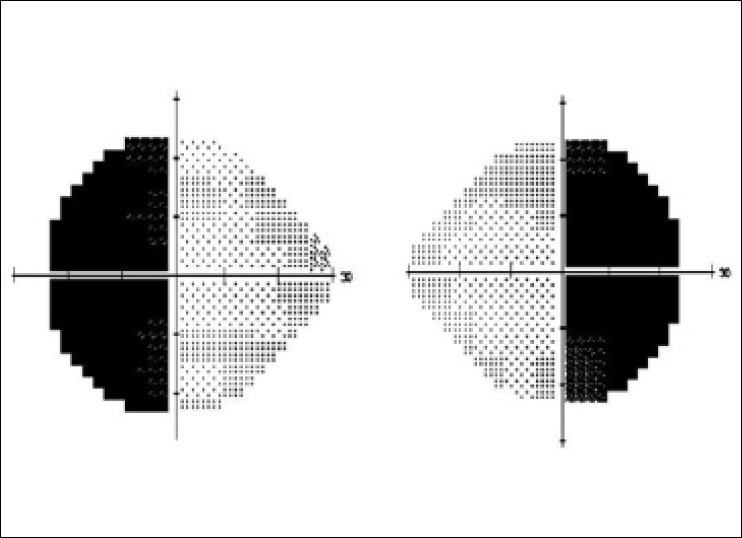
[looks at field test results]

Shit, that looks bad.

[Smiles]


5 minutes

So I think I should refer you to the consultant.

referral? that can’t be good. what does he mean?

[heart pounds, pupils dilate then constrict]

[Waits. Watches his face]

Can I take some blood today too?

Sure

what does he need blood for?

                                                                                                                                                [starts to roll up sleeve]

Is this right?

4 minutes

Great. Give me a moment.

[washes hands, hunts for needles]

Where are the bloody things? No-one puts anything back. Brain tumour for certain. Shit.

Don’t get many of those in. Mind you, I’ve only been here a year.

what does he want blood for? bloody doctors, never explain themselves.


3 minutes

Right, hold out your arm. Easy now.

[pierces skin with needle, adds vial, watches blood fill the vial.]                                                          OUCH!

Nice firm skin, good veins. That’s filling up nicely. Thank god he’s not another old lady.

[breathes. tries not to look at needle. looks. looks away, looks again as vial fills.]

shouldn’t have to watch as my blood leaves my body. i feel sick.


[slips vial into plastic envelope.

fills in form. starts to type letter]

he won’t meet my eye. he knows it’s bad

it’s a tumour, isn’t it? say it, say it.

2 minutes

[types]

How long will it be?

I’ll make sure I mark it as

a priority.

[turns back to screen. types]

[shifts on chair]

i was right. Priority. Urgent. i can’t breathe

is that another sign that …

i’m going to die.

1 minute

Poor guy. I don’t know what to say to him

Is there anything else?

I hope not. I’m running late.

he’s not looking at my face.

has he seen something serious?

what’s more serious than a brain tumour?

i’m going to die. i’m going to die.

No, that’s all. Thank you.

[exits]

Thank god that’s over. Got to make up time.

Bloody hell it’s Mrs Smith next. Intractable varicose ulcer.

What a morning. More old ladies, same old, same old. Should have trained as a consultant.


7 minutes                                                                                                                                                               thank you.

why did i fucking thank him?

He’s practically handed me a death sentence.

shit shit

shit.
Reworking: In ambit and catenary

In ambit and catenary he limits her still. As she walks the perimeter she knows each book, each pen, a girder, each fabric thread a chain, each bowl he used, a stop.

She stops, lifts, replaces it with care just where. If she leaves them he’s still here in traces DNA remains.

No crime scene here. He had that courtesy to leave their home, be gone before, in dreadful courtesy, she thinks, he chose with care just where         seventeen.

not two, not twelve, enough for no way back no track to follow, bring him out.

(The forest, dense, stands peaceful still, no crime scene there. Liberatur.)

No antidote, no undignified bout over days or weeks to drag him back.

She chokes on something in her throat. He swallowed seventeen (no boulders there). He made it stop before…

She’d seen him count each morning, night. Three, no more, kept him alive, go on.

His choice to leave.

She may grieve. Not yet. In grief a certain freedom lies, the chance to rage, to fly, to rave, unchained to earth, to let it go. Not yet.

She walks the house, perimeter. Pick up, replace, safe. A trace of him remains. In ambit and catenary she’s chained.


Disappearing people

She signed her maiden name for the last time, though her maidenhood had vanished seven years ago. In his car, fumbled condoms, new understanding of guilt mixed with thrill and disappointment. Why you haven’t got married before now I don’t know, her mother had said in the run up to the wedding.

She held her hand still, pen touching the paper, because when she lifted it, it would be done. Done, gone, whatever.

Her mother. Was she still her Mam? Brigid Kelly didn’t exist anymore. Her mother had named her, her father had gone, gone already, gone again. He kept departing throughout her childhood, constant in his unannounced goings. She thought that if she could see the pattern, spot the shift in violence, the element in the argument, the one word too many, that one more drink that let him release, she might understand, she might be able to control it. She might be able to avert his hand, close Mam’s mouth as she played her role, stop the slap and that step and the next one. She never worked it out, and it was right that he was absent today too.

“You’re making a blot,” the registrar said, so she lifted her hand and waited to see if anything changed, waited to see if she was still here. She’d read a joke once. What can travel faster than light? The answer was monarchy. It wasn’t funny, so maybe it was a riddle, not a joke. She waited to see if, in the moment of signing her name, like the moment of a king’s death, something passed at speed. Where had Brigid Kelly gone? Had she gone? Did she feel the same?  Her skin prickled.

She looked down at the ink sprawling across the page, black on white. And it spread across her dress, oyster silk shimmering into a negative, and Eoghan’s hair was white, not brown, his skin greyed out, hers too.

Maria’s hand touched her arm. “Bree?”

She blinked, and wondered if it had all happened already, perhaps she’d missed it, too wrapped in saying ‘I do’. Maybe Brigid had left ten minutes ago and no-one had noticed, not even …not even … who was she then?

Brigid Kelly.

He called her Bree now, all her friends did. Brigid had been her grandmother’s name, and even she had always been Bridie. Brigid slipped away from her too. It had been a shock when she heard her own name at the funeral, time after time, by an unknowing priest.

Now she was Bree Smith.

She pushed away from the table, her dress catching on the chair.

“Just pick up the pen again, love, one for the camera.”

They hadn’t even captured it on film, the moment Brigid Kelly vanished. She had to do it again. Fake pose, imitation smile, counterfeit signature. What could she sign away now? She saw the ink at the tip of the pen, the blot on the page that had already obliterated Brigid Kelly’s last traces. If she touched it again, would she connect?

“Come on Mrs Smith. Smile please.”

Mrs Smith. New name, new person. Maternal bulges in a worn tweed, shopping bags, something nice for his tea, love. She shook her head.

“Just Bree,” she said, and forced a smile to slide across her wedding make up.

Blindsided: Referral Letter

The EyeWorks

High Street

Bexhill


Dear Dr Keane,

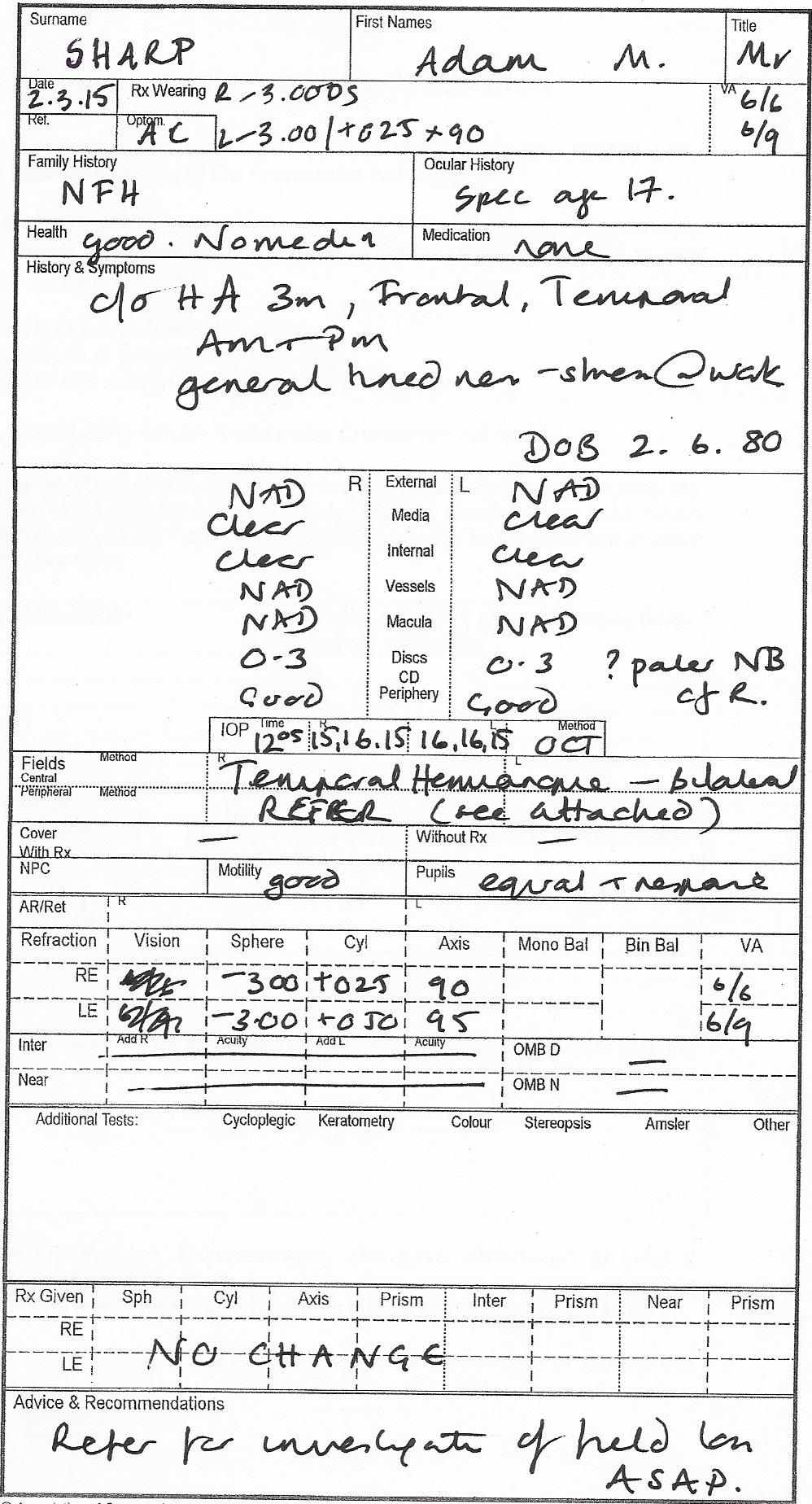
I examined Mr Adam Sharp, dob. 2.6.80 today. He attended c/o frontal and temporal headaches for the past three months.

I found a bilateral temporal field loss which has not been noted on previous examinations. I include a visual field print out.

Mr Sharp’s visual acuity has also dropped in his left eye from 6/5 to 6/9, and in his right from 6/5 to 6/6.

I would be grateful if you could arrange to refer Mr Sharp as a matter of urgency.

Best wishes


Clarissa Vider

Bilateral hemianopia