Blindsided: Waiting, or Meet Dr Google

What did the doctor say?

i don’t know. He’s writing a letter. i … i’m going to bed.

Tonight i shall search for Causes of sight loss

No, i’m fine. i’m sure I’ll hear soon.

Tonight i shall search for Causes of visual field loss

 Are you getting up, Adam?

No.

Tonight i shall search for Temporal field loss

 Do you want to talk about this?

No.

Tonight i shall search for Pituitary tumour field loss

i … i … just carry on reading from page 7. I’ll be … Outside.

Tonight I shall search for Pituitary adenoma

i can’t tell Kelly what I think. Can’t tell anyone.

Ptutary adenomas are generally slow-growng, bengn neoplasms whch can compress the anteror vsual pathway, resultng n loss of vson.

Can’t sleep. Still. What if i die? What if it gets worse before i die?

Tonight i shall search for Slow-growing, benign neoplasms

benign that’s kind. that’s good. isn’t it? is my vision getting worse?  i can’t go on like this.

Anatomc relatonshps suggest that tumor extenson 10 mm above the daphragma sellae s necessary for the anteror vsual pathway to become compressed.

 We need to talk, Adam. Take some time off. Talk to your boss if you won’t talk to me.

Trans-sphenodal surgcal resecton or cranotomy can decompress the anteror vsual pathway, leadng to vsual recovery.

Just leave it. i can’t talk about it.

Vsual mprovement occurs n three phases, wth the earlest phase of mprovement takng place one week after surgery. t has been postulated that the ntal mprovement n vson s the result of recovery of nerve conducton.

maybe it was smoking? i exercise enough, don’t i? i run, i used to run. i haven’t run since … Maybe i should switch the phone off. Do phones cause brain cancer?

Later mprovement s thought to be due to remyelnaton of decompressed optc pathways.

Fucking leave me alone. i’m going out.

Trans-sphenodal surgery s the surgcal treatment of choce for most ptutary adenomas because t s mnmally nvasve and hghly successful.

Kelly doesn’t get it. nobody gets it. i don’t want it. someone take this away. please

 Overall, VF returned to normal n 35% of eyes, mproved n 60%, and remaned unchanged n 5%. Patents whose VF returned to normal had a shorter duraton of symptoms (16 (5) v 137 (56) weeks; p<0.05), better preoperatve vsual acuty (p<0.05), and a smaller degree of mparment n preoperatve lateral quadrant VF (p<0.01) than those whose VF only mproved.

 There’s a letter from the hospital. Will you open it?

 When are they seeing you?

 What?

i can’t take time off.

 For God’s sake Adam, it’s your health. You’ve been in a right state these last two weeks. Look, I’ll see if I can come too.

can’t sleep. should stop lookng at my phone. what f t’s not bengn? they’re gong to have to open my bran up, cut nto me … sht.

Don’t come.

I’ve booked time off work. You shouldn’t have to deal with this on your own.

what if i … what if they …

I’m coming.
Blindsided: A consultation

‘This week’s exercise is about viewpoint. Please choose one of the scenarios below, and TWO of the viewpoints. Write the scenario twice, once from each view point. Don’t make it too long this week – aim for a few hundred words.’ (Exercise from The Book Analyst Facebook Group)

7 minutes

So, Mr Sharp, What brings you here today?

You had a letter from my optician.

should i sit here? should i take my coat off?

he looks bored. wearing a suit. i should look smarter.

[sits on edge of chair, picks at skin of edge of thumb]

frayed old jeans, grey hoodie, what’s the point?

Ah yes

[shuffles paper, looks on laptop, reads]

He looks worried.

Looks younger than he is.

Eight years older than me, though.

Shaggy brown hair, needs a haircut.

[runs hand through hair]I need a haircut. Better hurry up, I’m running late.


6 minutes

Ah, I see. Some headaches. How are they now?                                                                                      Much the same

blinding pain, stops me sleeping,

painkillers don’t make any difference

snapping at Kelly, can’t think, can’t sleep,

now i can’t see

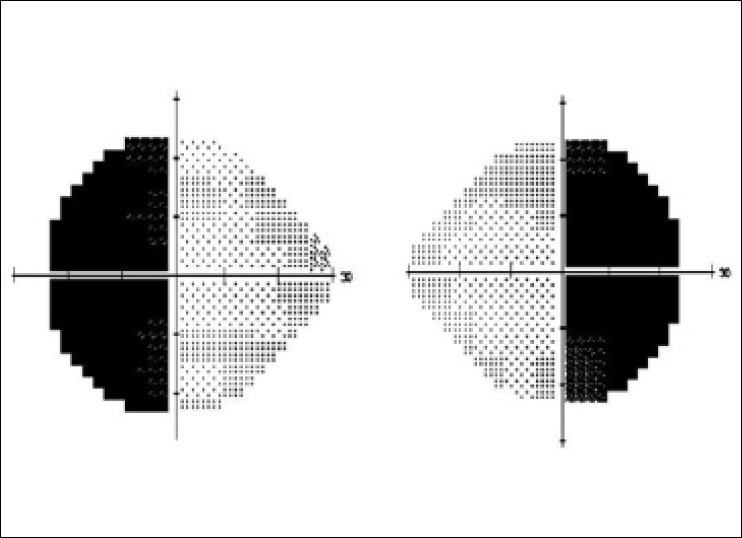
[looks at field test results]

Shit, that looks bad.

[Smiles]


5 minutes

So I think I should refer you to the consultant.

referral? that can’t be good. what does he mean?

[heart pounds, pupils dilate then constrict]

[Waits. Watches his face]

Can I take some blood today too?

Sure

what does he need blood for?

                                                                                                                                                [starts to roll up sleeve]

Is this right?

4 minutes

Great. Give me a moment.

[washes hands, hunts for needles]

Where are the bloody things? No-one puts anything back. Brain tumour for certain. Shit.

Don’t get many of those in. Mind you, I’ve only been here a year.

what does he want blood for? bloody doctors, never explain themselves.


3 minutes

Right, hold out your arm. Easy now.

[pierces skin with needle, adds vial, watches blood fill the vial.]                                                          OUCH!

Nice firm skin, good veins. That’s filling up nicely. Thank god he’s not another old lady.

[breathes. tries not to look at needle. looks. looks away, looks again as vial fills.]

shouldn’t have to watch as my blood leaves my body. i feel sick.


[slips vial into plastic envelope.

fills in form. starts to type letter]

he won’t meet my eye. he knows it’s bad

it’s a tumour, isn’t it? say it, say it.

2 minutes

[types]

How long will it be?

I’ll make sure I mark it as

a priority.

[turns back to screen. types]

[shifts on chair]

i was right. Priority. Urgent. i can’t breathe

is that another sign that …

i’m going to die.

1 minute

Poor guy. I don’t know what to say to him

Is there anything else?

I hope not. I’m running late.

he’s not looking at my face.

has he seen something serious?

what’s more serious than a brain tumour?

i’m going to die. i’m going to die.

No, that’s all. Thank you.

[exits]

Thank god that’s over. Got to make up time.

Bloody hell it’s Mrs Smith next. Intractable varicose ulcer.

What a morning. More old ladies, same old, same old. Should have trained as a consultant.


7 minutes                                                                                                                                                               thank you.

why did i fucking thank him?

He’s practically handed me a death sentence.

shit shit

shit.

Blindsided: Referral Letter

The EyeWorks

High Street

Bexhill


Dear Dr Keane,

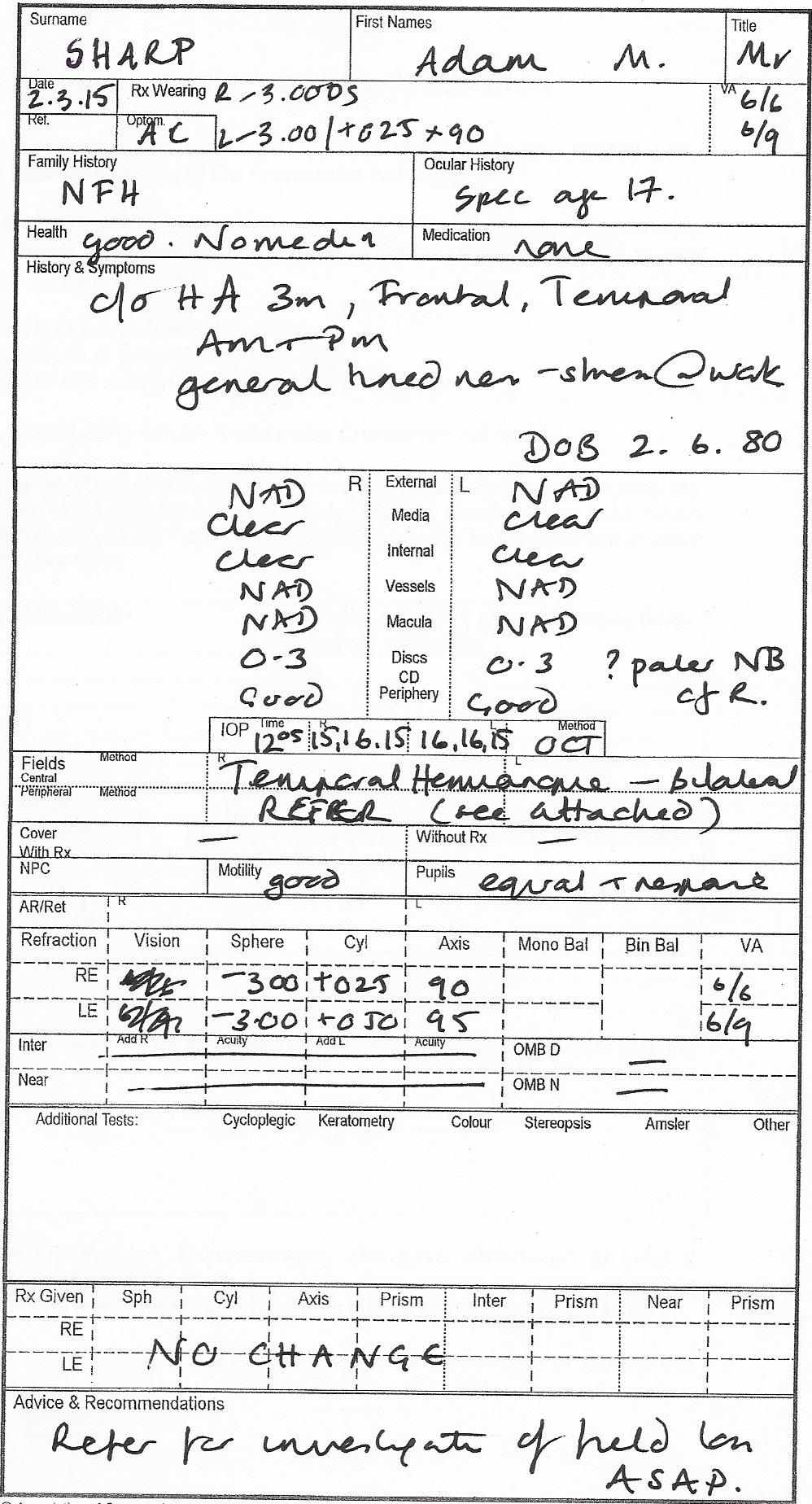
I examined Mr Adam Sharp, dob. 2.6.80 today. He attended c/o frontal and temporal headaches for the past three months.

I found a bilateral temporal field loss which has not been noted on previous examinations. I include a visual field print out.

Mr Sharp’s visual acuity has also dropped in his left eye from 6/5 to 6/9, and in his right from 6/5 to 6/6.

I would be grateful if you could arrange to refer Mr Sharp as a matter of urgency.

Best wishes


Clarissa Vider

Bilateral hemianopia

Blindsided: Glossary

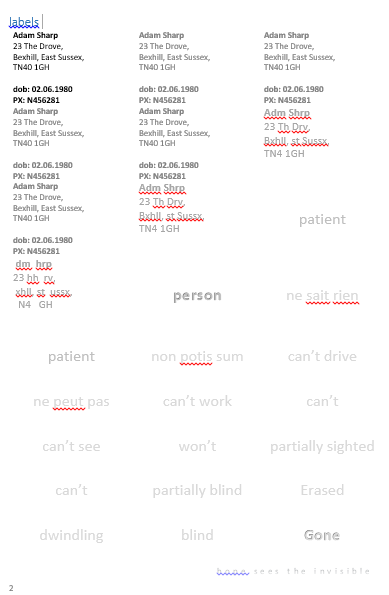
Person. This story is about Adam, a person.

Patient. In some people’s eyes, Adam is also a patient. These people are part of the medical establishment. To them, he is patient, has to be other, the object of their care. Without this otherification, he is dangerous. Sometimes Adam feels like he is no longer a person. Is he a number, an object?

Practitioner. Optometrist, General Practitioner, Registrar, Consultant Neurosurgeon, Health Care Assistant (HCA), Nurse, Porter, Theatre Nurse, Technician, Ear, Nose and Throat (ENT) Specialist, Consultant Anaesthetist, Consultant Neurosurgeon (again),  Registrar (again), Senior Registrar, Have I lost you yet? Adam feels lost amongst this barrage of qualifications, acronyms and hierarchies. Name badges make little difference when you can’t see. Nurse, Nurse Practitioner, Health Care Assistant (HCA), Porter, Consultant Neurosurgeon (again), Registrar (again), Senior Registrar (again), HCA, Nurse, Occupational therapist, physiotherapist, psychiatrist, counsellor, general practitioner

Paper. This is a term paper, which I present to you for marking. Within this paper is a fictional paper written by a fictional doctor for a fantastical version of a journal for doctors, the British Medical Journal, and outwith this paper is a paper on blindness that would not stay unwritten. Each sheet you hold is paper, pulped wood, smeared with petrochemicals. Inkjet ink will smear with tears. Papers determine one’s identity: in this paper you may find out more about Adam, about the relationship between person and patient, between patients and practitioners, about me, the author, perhaps about yourself too.

Record. This paper is a record, but what is it recording? A record is a testimony: I write this on behalf of those who cannot write, speak, see. Memory, statement, report, in black on white. A written account of event(s). An achievement. Nothing in here is off the record, but it seeps out from the boundaries of the record; what I have read sprawls across this record, bleeding print, ideas that haemorrhage unstopped

Story. Story, first, was history. Now, story is, ‘a narrative of fictitious events, designed for entertainment’. Beyond definition, story is elusive. It dances between fact and fiction, fragments and the whole. It lives in the space between the sheets of paper, not just in the inked words on each page. It finds a space in your mind: story is nothing without mindspace. Story is not, if it is not read, not told. Story is personal, of a person, for people. See, speak, write, create a story, find a (happy) ending.

Tumour. There’s a tumour in Adam’s brain. As a sneak preview, I’ll let you know it is a pituitary adenoma. Does that mean much to you? Never mind. A few millimetres of errant tissue in Adam’s brain changes his behaviour, his choices, his life, his story. Meaning collapses for him. Mind you, when the story starts, he doesn’t yet know that he had a brain tumour. Bear that in mind.

See. Seeing: we see without thinking, we ‘look, behold; observe, perceive, understand; experience, visit, inspect’. I see: I follow what you are saying. I see: I have (a) vision. Also, See, ‘throne of a bishop, archbishop, or pope’ from Latin sedem ‘seat, throne, abode, temple,’ related to sedere ‘to sit’. I do not see, I am unseated.

Blind. Lacking sight? Unable to see? Blindness is seldom total lack of sight: most blind people have some residual vision. For them, life depends on exploring what is left. Think of blindness as part-sight, ‘now we see through a glass darkly’. The original sense of blind comes not from ‘sightless’ but ‘confused,’ underlying phrases like blind alley.

Sight. A thing seen, esp. of a striking or remarkable nature; a spectacle, a vision. The apocalypse. Something which calls forth contemptuous, horrified, or amused glances; a shocking, repulsive, or ridiculous spectacle. A show or display. Aspect, appearance, look. The perception or apprehension of something by means of the eyes; the presentation of a thing to the sense of vision. A view, a glimpse. Hold all these aspects of sight in your mind’s eye.

Loss. Something is missing, disappearing. At first imperceptibly, sight vanishes. Adam becomes aware of this slowly. Something in this eludes me, I cannot address it adequately in 6000 words. Practitioners lose perspective. Adam loses his personhood, loses half his field of vision, loses his …

… Pouvoir. (French) v. to be able to, can, may, might, n. power. From the Latin, potis sum, to be master of. Command, agency. Adam loses his ‘pouvoir’. Some is snatched from him, physiologically, some is taken by a system that disempowers him. Impuissant, he cannot see, so he cannot [………..].

… Savoir. (French) v. to know, to see, to be aware, to realise. n. knowledge, learning scholarship. from Latin sapere, (nominative sapiens), from PIE root *sep- (1) “to taste, perceive”. Homo sapiens – to be human? Knowledge, empathy, understanding all are needed to be a medical practitioner. Henry Marsh writes in Do No Harm, the voice of the practitioner for the purposes of this paper, ‘illnesses happen to patients, not to doctors.’ (p215) Knowledge, savoir, has a protective function. Adam is unseated, unsettled, uncertain, sans savoir.

Blindsided: instructions

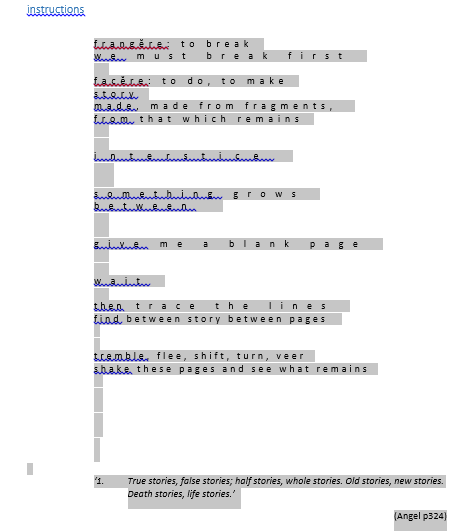
blindsided instructionsfrangĕre: to break

we must break first


facĕre: to do, to make

story

made, made from fragments,

from that which remains


interstice


something grows

between


give me a blank page


wait


then trace the lines

find between story between pages


tremble, flee, shift, turn, veer

shake these pages and see what remains


‘1.           True stories, false stories; half stories, whole stories. Old stories, new stories. Death stories, life stories.’

(Angel p324)

Blindsided: story in pieces

[Interstitial: n. Of an intervening space; esp. a relatively small or narrow space, between things or the parts of a body, of the minute spaces between the ultimate parts of matter. From the Latin, interstitium, space between]

[fragment: transf. and fig. a broken piece; a small detached portion, a part remaining or still preserved when the whole is lost or destroyed. from the Latin, frangĕre to break]


What images have burnt a trace in your mind when all else is forgotten? What stands when all else has fallen? What do we take with us when we flee?

Story burns, story stands. Story defines and identifies.

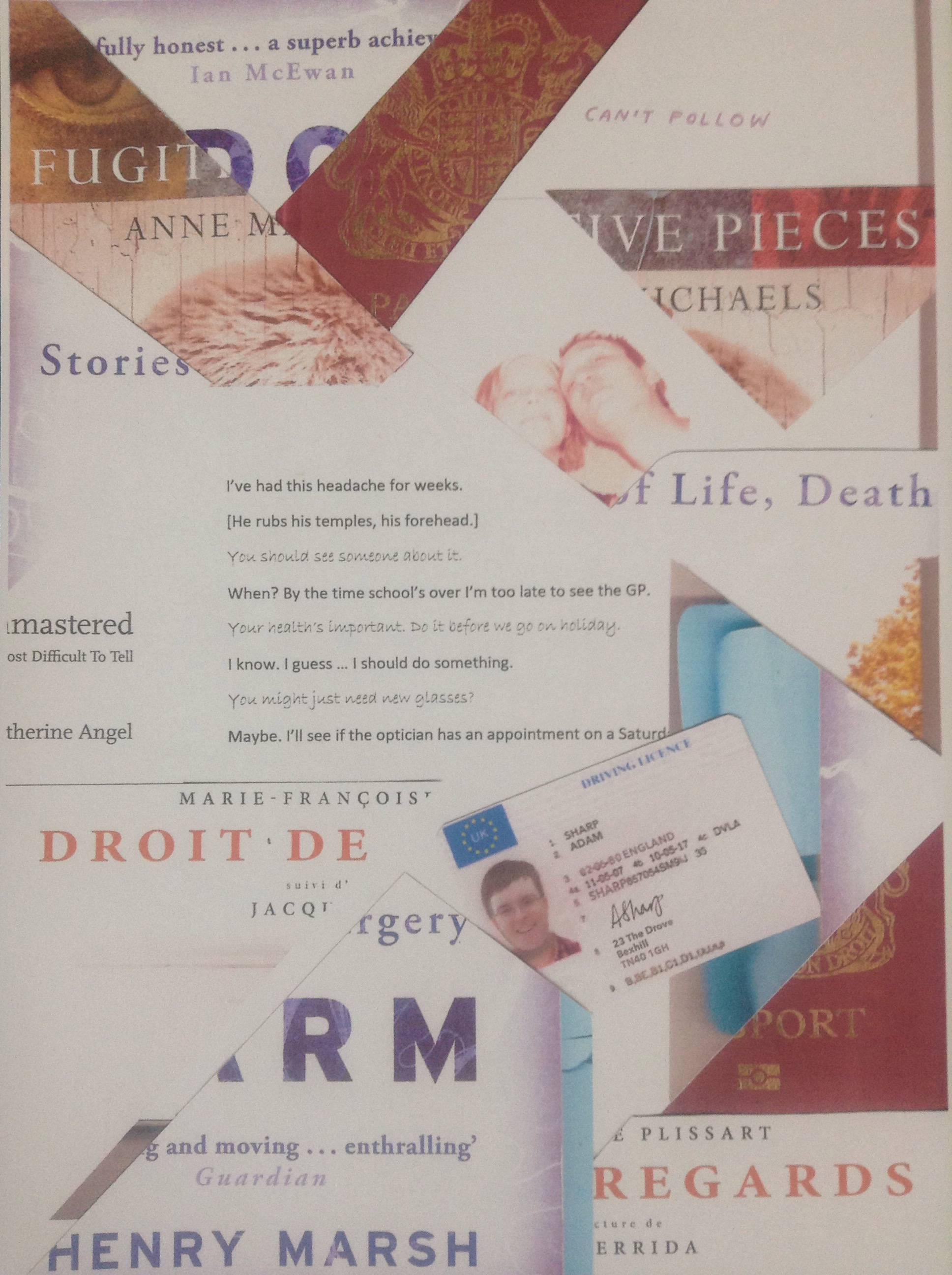
Anders Nilsen compiled Don’t go where I can’t follow, a story told in postcards, letters, cartoons, scraps torn from his jottings as his fiancée Cheryl was torn from him, from life. A camping trip, photos from when they visited France, then everything changes with the black and white text and sketches in The Hospital. After that, The Lake, the graphic story describes how Anders scatters Cheryl’s ashes where they had planned to marry. The book was first created as a memorial for friends and family. A relationship in ninety pages, this assemblage is as moving as thousands of words. It tells the story.


[fugitive adj. Apt or tending to flee; given to, or in the act of, running away. From the Latin, fugĕre to flee]


Story is elusive. Scattered snapshots, some burnt, blow across the pine needled forest floor. The house no longer stands, the people have been taken away, but a child hid in a gap in the wall, and now he is running too, so the story can go on … start … flickers, traces of memory, Fugitive Pieces, blurred memories tainted and torn by trauma, as in The Drowned City, the first section of Anne Michael’s novel. Chase the story, run it down, pursue it, consume it until it is part of you that only ends with death.


[fiction n. arbitrary invention, that which is fashioned or framed, counterfeiting, the action of ‘feigning’ or inventing imaginary incidents, existences; the species of literature which is concerned with the narration of imaginary events and the portraiture of imaginary characters. From the Latin fictiōn-em , noun of action, fingĕre to fashion or form]


Experimental stories glide into your mind, unseen, seep, creep, slide. Their presence eludes touch, but they are there, none-the-less. Expect no start, middle, end, no neat ravelling of threads to form a rope evenly over pages, chapters. When you close the book the rope is there, none-the-less.

In Katherine Angel’s Unmastered, A Book on Desire, Most Difficult to Tell a woman meets a man, has sex, conceives, has an abortion; ‘and then down, down, down, further and further I tumbled – Alice, pointy boots, tressed hair, topsy turvey into a tunnel of grief, into its numbing invisible embrace.’ (p238) Abortion reverberates through her life, through the white spaces in her book where something elusive starts to become present, something intangible, something that changes texture when you try to grip it.

‘5.           Years later I roamed, stunned, excited, through the Neues Museum in Berlin: rebuilt, restored; the archive of itself.

Its wounds preserved, lovingly rendered. Its memory on its skin.’

(p282)

Story emerges, unbidden, unbound.


[borrow: v. To take (a thing) on credit, on the understanding of returning it, or giving an equivalent; a thing recognized as being the property of another, to whom it is returnable.]


The pieces for this story are borrowed, appropriated, adapted. I learn through others. I take what I am given, and that which I am not given. I consume, devour other people’s stories to narrate my own.

Life’s events force story: we are compelled to tell our stories, of trauma, of change. Life is rich in complexity, messy, uncertain, relationships are tangled, and however much you want closure, a creative writer’s perfect plot, the script writer’s story arc, neat endings are unlikely. As Anne Carson writes, ‘The fragments of the Geryoneis itself read as if Stesichoros had composed a substantial narrative poem then ripped it to pieces and buried the pieces in a box with some song lyrics and lecture notes and scraps of meat … you can of course keep shaking the box.’(P6-7). That is life, that is writing about life.


[shake: v. to move quickly to and fro. To vibrate irregularly, tremble. To shiver, vibrate, flutter.intr. A poetical word for: To go, pass, move, journey; to flee, depart, in physical and non-physical senses.]

[unsettle: v. to force out of a settled condition; to deprive of fixity or quiet, not peaceful, not firmly established.]


Ref

  1. Marsh, Henry, Do No Harm, Stories of Life, Death and Brain Surgery (Phoenix, London, 2014)
  2. Jay, Martin, Downcast Eyes University of California Press 1994
  3. Nilsen, Anders,, Don’t go where I can’t follow (Drawn and Quarterly Quebec 2012)
  4. Michael, Anne, Fugitive Pieces (Bloomsbury, London, 1998)
  5. Carson, Anne, Autobiography of Red, (Jonathon Cape, London 1998)
  6. Angel, Katherine, Unmastered, A Book on Desire, Most Difficult to Tell (Allen Lane, London2012)
  7. Inspiration for word definitions derives from oed.com and etymonline.com accessed 3, 25, 28 March 2015 and Downcast Eyes (referenced above)

Blindsided: Introduction

‘My first sight on entering the consultation room was a Babel-like tower of multi-coloured folders containing the patient’s notes … a tower of sheets of paper, bursting out of dog-eared files, in which the recent relevant results have rarely been filed, and if they have been filed, have been filed in such a way that it is usually very difficult to find them.’

(Marsh 2014 p264)

Aspects of people’s stories can be found between the pages of a medical record, yet medical records are about the patient, not the person, for the practitioner. In much of what we have read this term the overall story is an accumulation, something found in the words on the page but also in between the words, between the pages, within different styles and formats, which makes me think of the way that a medical record works.

I want to unsettle conventional expectations of a medical record and use it as inspiration and as a place to contain poetry, prose and critical work, the scaffolding for the story of a person. Because of my background as an optometrist, I have written about sight loss, and explore issues of changing identity in relation to shifts related to sight loss. Sight loss unsettles the human experience in the same way that experimental writing can. It forces you to look in a different way, use different parts of your vision, your brain, your mind. Did you know that people with cortical visual impairment may not be able to ‘see’ an object, yet can still react to its presence?

Our senses are dominated by the visual, and as Martin Jay explains in Downcast Eyes (1994 p3), so is our language. Development of sight comes late to the foetus, and much only happens post birth. Since the industrial revolution our culture has shifted from oral to visual. In the imagination, our brains prioritise images over sounds and smells. The visual function takes a disproportionately large part of our brain, and it dominates this paper. Visual metaphors recur throughout. French creeps into this paper, as does Old English, as does Latin, language of medicine, in attempt to seize back jargon, to own language, on behalf of the patient, the person, my self.

With more space and time I would have included letters – a medical record is packed with referral letters between practitioners, post it notes, perhaps the person’s own notes, letters and thoughts. There is a further critical paper on sight loss in literature that I could not include due to constraints of space. This story spills out beyond these sheets.


Ref

  1. Marsh, Henry, Do No Harm, Stories of Life, Death and Brain Surgery (Phoenix, London, 2014)
  2. Jay, Martin, Downcast Eyes University of California Press 1994
  3. Nilsen, Anders,, Don’t go where I can’t follow (Drawn and Quarterly Quebec 2012)
  4. Michael, Anne, Fugitive Pieces (Bloomsbury, London, 1998)
  5. Carson, Anne, Autobiography of Red, (Jonathon Cape, London 1998)
  6. Angel, Katherine, Unmastered, A Book on Desire, Most Difficult to Tell (Allen Lane, London2012)
  7. Inspiration for word definitions derives from oed.com and etymonline.com accessed 3, 25, 28 March 2015 and Downcast Eyes (referenced above)