An’ here I go again on my own … Blindsided

blindsided coverIt’s term paper time. Experimental writing term paper time. Whatever comes up next on the blog should perhaps come with a warning. It’s written for a very small audience: people who are interested in sight and blindness along with experimental writing and the avant garde. I suspect I may be the only person in the centre of this Venn diagram … but I’ve been bitten hard by this one, it’s obsessing me, and I have so much more written than will fit in the term paper, and it’s all going to end up here …

watch this space

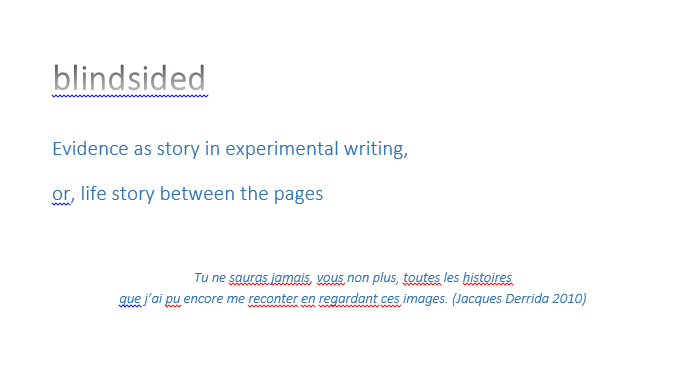
The title is Blindsided. Visual metaphors ripple through the work.

watch this space


Ref

quote: Derrida, Jaques, Droit De Regard (Les Impressions Nouvelles 2010)

Writing exercise: prompt from opening sentence

Head high, she swept out of the room. A second later, head even higher, she swept back in, snatched up the money and was gone again.
Tom glanced at Jane.
Jane shrugged.
Not my daughter – he could almost hear her thoughts. He sighed, raised his eyebrows, then stood.
“Right, let’s go. Kelly can meet us there when she’s ready.”
“If she wants, “Jane said.”Don’t make her.”
Don’t make things more difficult: more words they couldn’t say. He took Jane’s hand. “Is the Italian going to be all right?”
“It’s fine. I don’t feel that sick any more, in fact, I’m hungry!”


In the car on the way to the restaurant, he said, “Do you think she’ll …?” then he stopped.
“Meet us there? Buy her Mum a gift? Just give her time, Tom, she’s a good kid.”
“I know, but she’s angry right now.”
“It isn’t easy – new house, new step mum and now,” she glanced down, “new baby brother or sister.”
Tom half-smiled. “I heard her on the phone to a friend – apparently it’s gross!”
“The baby?”
“The thought that we’re having sex!”
Jane laughed at him. “I remember feeling like that when Mum got pregnant with Lucy, I was 12 then, not quite as old as Kelly.”

They were sitting near the window, menus open, drinks on the table, one space still vacant. The waiter lingered nearby and Tom looked at his watch. “We should order.”
“Give her a few minutes more,” Jane said. “Look, there she is!” Kelly was hurrying up the path to the restaurant, her arms full. “I think she’s got her Mum something too.”
Tom exhaled. Mothers’ Day might be going to work out.
Kelly burst into the restaurant, then thrust her package at Jane. “Happy Mothers’ Day.”
Jane flushed, then started to open her gift.
As she did, Kelly said, “Dad, I need more cash to get a gift for Mum!”

For the Book Analyst Writing Group

Nikki Young Writes
mumturnedmom

Exercise: Writing from Two Points of View 1

POV 1
She could see him, still in the hall, jacket on.
“Are you stopping, Daniel?” she called. “I’ll put the kettle on.”
She filled her hands with cups and saucers, the little set they found at that fair up past Whitby. It had been a bargain, even if it had been hard to keep it intact, two teenagers and a five year old in the house.
She glanced into the hall again. It was hard to match up the ruddy cheeked five year old, always trying to keep up with his brothers, with the six foot man who was hesitating out there. It wasn’t like Daniel to dither she thought as she placed the cups out carefully. She poured boiling water into the matching teapot, swirled it, tipped it out and refilled it, all the time fending off the fear that Daniel was hesitating for a reason.
‘Mum’s always together’, she’d heard one of the boys say, and she did keep it together, for them, but this year, last year, … she couldn’t word what had happened, still too raw. She ran the back of a finger under her eyelashes and glanced into the hall again. He seemed lost in thought and she was glad Tony was down in the garage.
She carried the pot and cups over to the table, laid them just so, appreciating the glow of the apricot china against the pale yellow Formica surface. She’d managed to keep that nice, no stains and not too many scratches. Daniel stepped forward, stopped, and then finally came into the kitchen.
“Mum. I need to tell you something.”

POV 2
He found her in the kitchen, had sought her out there where she was most her, most at home, most likely to accept. Dad was at work, he’d seen Sam head in to the hospital, knew Lucy was in nursery, the children in school. No reason to be interrupted, he turned off his phone. He’d had it on for months, it seemed, waiting for the next call, the next sign that the family was disintegrating. This time, he was choosing to deliver the blow, choosing to risk pushing everything a little further apart.
“Are you stopping in the hall, Daniel?” Mum called. “I’ll put the kettle on.”
“K.” He didn’t walk on, though, still waiting for some sign, some clarity. Sam had said it was fine. Fine: who needed approval? Dan sighed. He did, or he wouldn’t still be here in the hall, wouldn’t be hovering, waiting to tell, to ask. What happened if she said that she didn’t believe him, it couldn’t be true? Or worse, what if she believed him, and thought it was wrong. It didn’t fit with their faith, for sure. But maybe that was in head, there were gay Catholics, after all. He could almost hear Sam’s voice, saying, “You’re overthinking it.”
He shook himself, took a step forward. King of overthinking: that was Sam, not him. For a second he wished he’d brought Sam down too, for back up, to diffuse things if it looked like Mum was going to blow up. But she wasn’t like that, and he could do this. On his own.
“Mum. I need to tell you something.”

For the Book Analyst Writing Group

On Edward Hopper’s Automat

Automat 1

I slip off one glove, can’t touch the cup through leather, other skin, can’t feel the heat rise. I want my capillaries to dilate, my fingers to glow, something good, so I slip off my glove. Keep my face down, eyes gaze at coffee swirls, listen to the machines in background whirr. I wait.

He’s watching me, behind the counter. I’m alone, object of curiosity, objectified, warm air on my décolletage, wish I had a scarf, more fur, to shield, drape, hide me. Watch the patterns on the table swirl, white formica stained where he has wiped, cleaned, wiped again, white dance on white spins before my eyes in time with the whoosh and swirl of the drinks machine.

Silk on my skin, silk lining in my dress, my coat, no shield. I can’t go back, won’t go forward, not ready, not yet. Automat coffee, automat life, never tasting quite right, not like the fresh version everyone else is living, having, man behind the counter, going home to his kids, his wife, dinner on the table for him. Not me.

The coffee’s black, too bitter, cooling, can’t face the dregs, still hold the cup, hope of warmth fading. False life, false hope, but as long as I sit here, stay here, nothing will move on. I leave the last inch of coffee, a promise that there’s something more. Soon, I’ll leave, before he wipes the table one more time, before he stacks the chair. Soon, I’ll move my legs, one foot then the other, slip out from warmth to the cool night air, from limbo to action, the next step. But for now, I wait.

For the Book Analyst Facebook Group Writing Exercise

Review: Reasons to Stay Alive by Matt Haig


How do you write a traumatic life experience like depression? In the midst of it, picking up a pen and exploring your feelings is impossible.

Why do you write about depression? Because when you are deep within depression, it feels like no-one else in the history of time has ever felt like you … and once you have reached a place beyond depression, maybe you want to let others know about that elusive thing called hope.

When do you write about depression? When the drugs have started to work? When you feel like you’re living again? When there’s something new to say, or something only you can say, or the impulse to write it is too great and none of what you have written so far quite deals with the itch, the need, to stop other people hurting in the same way that you hurt?

I don’t think I’ve every written properly about being depressed. Much of it is a blur: the parts I remember will be hard to write and painful to share. Maybe, 13 years down the line, I haven’t yet reached that point.

Matt Haig experienced depression in his twenties, and now, around 15 years later, he had finally addressed it head on in Reasons to Stay Alive. It’s a beautiful book, pocket sized, white binding, orange inner covers, rainbows dancing across the paper outer. And inside, it’s beautiful too.

The writing takes the form of scattered pieces, part memoir, part lists, a few selected tweets, and the story builds between the short chapters and sections. I don’t always finish every book I start, for a range of reasons, but I finished this one. It’s honest. It’s compelling. And it doesn’t tell you not to be depressed.

Haig skilfully avoids the ‘them and us’ of most self help style books: he’s there, deep in the depression, he’s there again as his current self, offering help, proof of a future, and most importantly, hope. He does end with 40 bits of advice on ‘How to live’, but none of it is preachy, it’s all tempered by the fact that he admits he doesn’t always follow his own advice.

And to finish, here’s one bit from the book that I love …

Self-help

How to stop time: kiss.

How to travel in time: read.

How to escape time: music.

How to feel time: write.

How to release time: breathe.


Reasons to Stay Alive is an incredibly low priced £6.99 at time of writing. Well worth a read whether you have been depressed, or want to understand someone else a little bit better.

Experimental writing workshop 4: Create Your own Writing Exercise

Writing in a box

this term we have been exposing unwritten rules about writing.

Do you always start sentences with a capital?

why? because you were told to? what happens if you don’t?

writing without rules, outside rules, with new rules, your own rules, any sort of experimental writing, is scary, exposing, liberating.

try to write with new rules, with the rules that you devise yourself, with

my rules,

his rules,

her rules.

when you write like this Do you find a new you?

have you got a pen? do you need one to take part in this class? do you have to write with pen on paper, black on white? black marks on a screen? what happens if you write in white on white?

does your writing need to be understood?

Take away the rules of writing, and what are you left with? There’s nothing scarier to a writer than a totally blank page: at the same time that page is full of potential, the perfect object of desire.

Give me space to write and I could write anything.

So, here goes. I’m giving you a space to write. Space with new walls, new rules.

Go to the supermarket, the café, the corner store. Hang out at the back, try not to look too suspicious. Eye up everything they have chucked out until you find the cardboard boxes. Look for the biggest box you can find. If you live near Ikea, all the better. Pick a box, big enough to fit a body in. Take it home.

Set up your box. Use tape to reassemble it if it has been flattened. Switch off your phone.

Take your box, and find it a place. This might be the bathroom, perfect if it has no windows. What about the basement, the attic?

My basement is concrete lined and dark.

Find a marginal space, somewhere you won’t be disturbed. If there are windows, pull the curtains.  Lock the door. If there is a light, put it out. Do you need clothes? If not, disrobe. Pick up your pen: I did say that you’d need a pen, didn’t I. Choose the colour of your ink.

My ink is white.

Climb into your box, seal yourself inside, sit there, legs furled, pen in hand. Eyes shut.

Feel the card against you, warm card, warm skin. Do you want to move, wriggle, shuffle? Adjust your position until you can be still, then sit again until the bones of your pelvis burn and your spine fuses.

Listen. What can you hear in your box? Water flowing through pipes? The rustle that might be mice? The rub as you breathe in and out? The whoosh of blood in your ears. Impulses racing down nerves, the message each sound sends to your brain? Listen until you can hear your irises dilate.

Open your mouth. What is on your tongue? Is the air stale, metallic? Can you taste the last meal you ate, lingering garlic? Do you thirst? Salivate, and taste yourself.

Inhale. Smell the room around you, your own scent, that of the box. Stay there, stay with that, how long do you need to stay there before it changes? When do you end up immersed in the scent of your own excreta?

Now, open your eyes. What can you see? Is it dark in your box? It’s not, not really, not if you have sat there long enough for your irises to dilate, your rods to adapt, for every cell in your retina to scream for stimulation. Track the lines of light where the box is made, the outside world seeping in through cracks and corners, follow them round and round, up and down, trace them with your gaze until your head spins and you no longer know which way is up.

Now write.

Write your heart beat, write your enclosure, write out, write infinity. Write secrets, write blindness, write what you know and what you don’t know, never knew, will never ever know again. Write on the walls of your box until they are covered, and when you have covered the walls write on your own skin, until there is no boundary between you and your box and your pen has run out of ink. And if you need to write more, you must write in your own blood.

When you have written, burst open your body, your box, cardboard sprawl on carpet, on concrete.

Flatten your box. Expose your words, let light in and see the true colour of your ink.

Lie on your box and be your words. Ride them, wavewords, ride them, sightless horses, ride them ecstatic until they cast you back on the shore.

Spent.

Bibliography

Helene Cixous The Laugh of the Medusa (1975) in The Routledge Language and Cultural Theory Reader, 2000

Helene Cixous Writing Blind, in Stigmata, Routledge 1988

CA Conrad A Beautiful Marsupial Afternoon
More writing exercises: 10-1 & A-Z

Alongside the exercises we’ve been doing on writing with constraints as part of the Experimental Writing module, I’ve been inspired by some of the writing exercises that Nikki Young has found and Maddy at WritingBubble has been doing too. Here’s an attempt at a 10-1 story: 10 words on the first line, 9 on the second and so on. I struggled most with the single word at the end – I wanted a 1 word sentence rather than a sentence split over two lines! 10 to 1 “I don’t feel appreciated, you never notice what I do.” “I always notice, even if I don’t say anything.” “So, why don’t you say thank you? Ever?” “I’m grateful, really I am.” “Would you notice if I left?” “Of course I would, love.” The laundry mounted up. Dishes went unwashed. She left him. And an A-Z story, staring each sentence with the following letter of the alphabet. A to Z As she walks down the street she plans her day. Both boys had been fractious, and her sleep had been broken. Coffee is the first thing on her agenda. Depositing the boys at nursery had been a relief. “Escape,” she thinks, cup in hand, but she turns towards home. For a second she isn’t a mother, isn’t due back at midday. God knows who thought two and a half hours of funded childcare was enough to do anything. Hurrying down the street, she flings open the front door, slams it shut and throws off her coat. Ignoring the dishes, the laundry, she opens her notebook. Just enough time, she thinks, as she glances at the clock. Knowing herself, she doesn’t open the computer, doesn’t log on to a virtual world of tempting ways to waste the morning. Leaving her phone in her coat pocket means she’s less likely to be interrupted, too. Mind blank, pen in hand, she stares at the page. No idea what to write, again. Precious moments slip by as she procrastinates. Quite some time back she realised that mother-writer was uncomfortable, impossible. Rarely could she wait for the muse to strike. She has to write now. These hours are it. Under two hours, she notes as she glances at the clock, and not one word on the page. Very often, she struggles for inspiration in the first hour, hour and a half. When twelve o’clock comes, though, when she should be racing down the road, her pen is usually racing across the paper. X, y,z, a, b, c, she doodles random letters, waiting for the words to emerge. Yesterday’s story mocks her, seems flat as she looks back at it for inspiration. Zooming on her way to nursery again, late again, she thinks about the words she finally managed to write, the speed with which they escaped from her pen when the block released, and how she can make more time to write tomorrow.

Muddled Manuscript


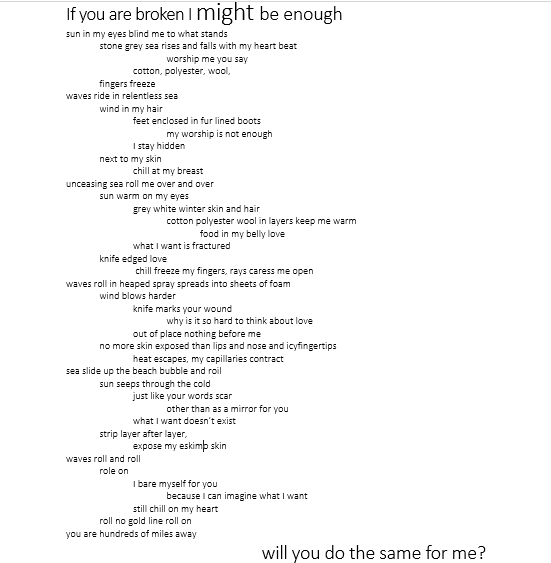
Knife-edged Love

If you are broken I might be enough

sun in my eyes blind me to what stands

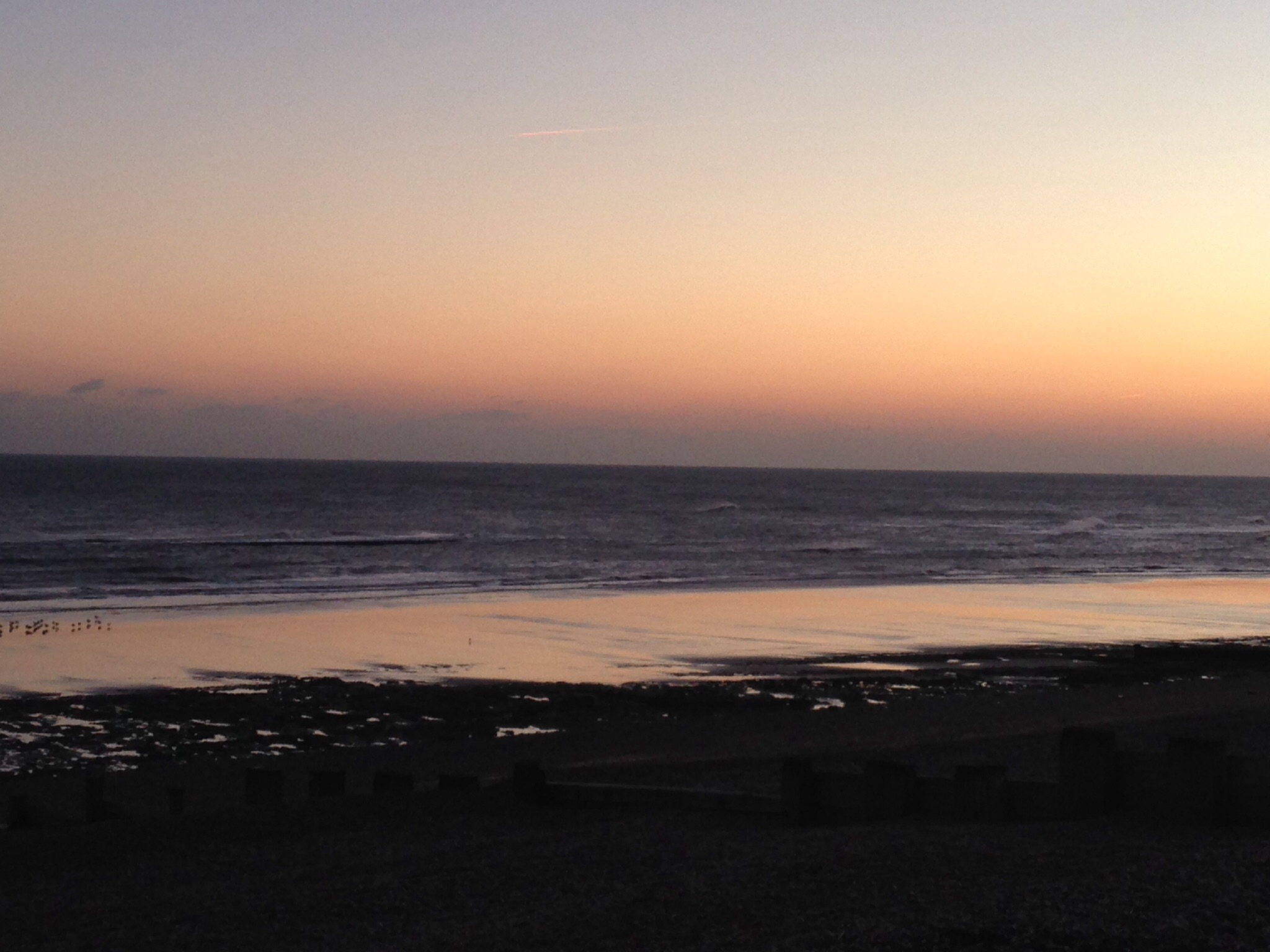
stone grey sea rises and falls with my heart beat

worship me you say

cotton, polyester, wool,

fingers freeze

waves ride in relentless sea

wind in my hair

feet enclosed in fur lined boots

my worship is not enough

I stay hidden

next to my skin

chill at my breast

unceasing sea roll me over and over

sun warm on my eyes

grey white winter skin and hair

cotton polyester wool in layers keep me warm

food in my belly                love

what I want is fractured

knife edged love

chill freeze my fingers

rays caress me open

waves roll in       heaped spray spreads into sheets of foam

wind blows harder

knife marks your wound

why is it so hard to think about love

out of place nothing before me

no more skin exposed than lips and nose and icyfingertips

heat escapes      capillaries contract

sea slide up the beach bubble and roil

sun seeps through the cold

just like your words scar

other than as a mirror for you

what I want doesn’t exist

strip layer after layer,

expose my eskimo skin

waves roll and roll

role on

I bare myself for you

because I can imagine what I want

still chill on my heart

roll no gold line roll on

you are hundreds of miles away

will you do the same for me?

Experimental writing workshop 3 (First Draft)

This week we can either:

1. write about being naked in a truck full of strangers in another, imaginary, world. how will we SHOW the differences, sociologically and anthropologically, by the interactions between us and our fellow prisoners. (Ref, Le Guin, The Left Hand of Darkness)

2. construct a physical world and write about it.

3. write about love without the use of gender pronouns.

I pick 3.

Please excuse the French in the first draft, as I have put this all down very quickly – any corrections gratefully appreciated (plus my Petit Robert fails me on limerance and liminal!)

frontier love

to love = aimer


we love without borders

in limerance I give myself to you

no holding back, no baggage

our love is perfect

hold this/that moment


je suis

tu es

nous sommes

nous tombons

nous sommes tombé(e)s amoureux


a border divides us, a sea, a language

I don’t know why I think I can love in French when my love in English is imperfect


nous aimons

nous avons aimé(e)s

nous aimons quand …

nous avons aimé(e)s

nous aimons sans frontières

en limerance je me donne à toi

sans retenue, aucune bagage

notre amour est parfait

maintiens ce moment


I am

you are

we are

we fall

we fell in love, we fell loving

une frontière qui nous divise, une mer, une langue

je ne sais pas pourquoi je pense que je peux aimer en français quand mon amour en anglais est imparfait

we love

we loved

we were loving when …

we used to love


under au dessous de La Manche, 250 feet below sea level, ca c’est soixante seize mètres a toi, I pause, je m’arrête, weight of water (l’eau) crushing me m’écrase

as I travel again comme je voyage encore

liminal space/espace liminal

my life divided/ma vie divisée

from yours

no we. oui?

If you say tomber en amour to a French(wo)man, s/he/they/we may start looking for holes.

to see: voir

the sea: la mer

je traverse la mer de te voir

je deviens une mère/un père

tu deviendras un père/une mère

nous serons des parents

unspeakable difference